


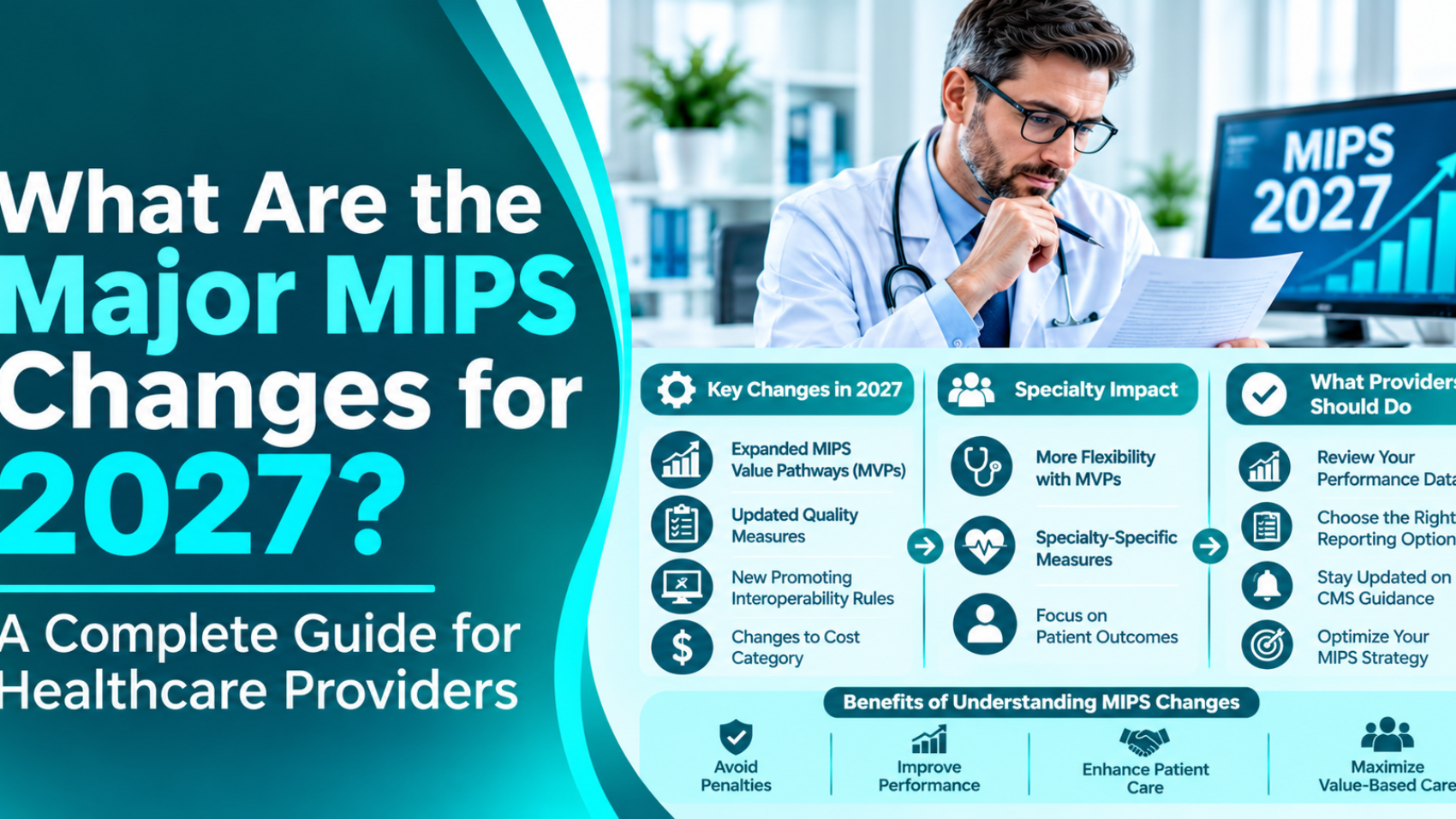
The 2027 performance year introduces important changes to the Medicare Merit-based Incentive Payment System (MIPS). Under the Calendar Year (CY) 2027 Medicare Physician Fee Schedule Final Rule, CMS is changing Quality reporting requirements, expanding MIPS Value Pathways (MVPs), introducing specialty-specific Core Measures, and updating Promoting Interoperability (PI) requirements. These changes affect how eligible clinicians select measures, prepare reporting data, and plan their Medicare quality reporting strategies.
One of the most significant updates is the new MIPS Core Measure requirement. Beginning with the 2027 performance year, most eligible clinicians must report at least one applicable Core Measure as part of their Quality performance category. CMS is also adding three MVPs, making electronic prior authorization an optional bonus opportunity in 2027, and continuing its transition toward MVP-based reporting.
Healthcare organizations should review these changes before the performance year progresses. Measure selection, EHR configuration, documentation, and reporting workflows can all affect the accuracy of a MIPS submission. For a broader overview of eligibility, reporting pathways, performance categories, and preparation steps, read our guide to 2027 MIPS Reporting Requirements.
This article explains the finalized 2027 MIPS changes, what they mean for healthcare providers, and how medical practices can prepare.
Quick Overview: Major MIPS Changes for 2027
| MIPS area | 2027 update | What providers should know |
| Quality reporting | New Core Measure requirement | Most eligible clinicians must report at least one applicable Core Measure. |
| Traditional MIPS | Six Quality measures generally required | The six-measure requirement continues, with the Core Measure included where applicable. |
| MVP reporting | Four Quality measures generally required | MVP participants must include an applicable Core Measure or follow the no-applicable-measure process. |
| Small practices | Core Measure exception | Small practices are exempt from the Core Measure requirement and the related attestation. |
| Quality inventory | 180 measures | The finalized inventory includes 177 measures available for traditional MIPS and MVP reporting and three MVP-only measures. |
| MVP options | Three new MVPs | Diabetic Disease, Hospitalist, and Hypertension MVPs bring the total to 30. |
| Virtual groups | MVP eligibility begins in 2029 | Virtual groups continue under applicable traditional MIPS rules for 2027 and 2028. |
| Promoting Interoperability | Security Risk Analysis measure removed | Removal of the MIPS measure does not remove HIPAA Security Rule obligations. |
| Electronic Prior Authorization | Optional bonus measure | Eligible clinicians may earn 10 bonus points in 2027 by meeting the finalized measure requirements. |
| Ambulatory Specialty Model | Mandatory model begins | Selected physicians must follow applicable ASM requirements and reporting deadlines. |
| MIPS performance threshold | 75 points | The 75-point threshold continues in 2027; it is not a newly introduced requirement. |
| Traditional MIPS transition | Traditional MIPS remains available through 2030 | CMS plans to end the traditional MIPS reporting option beginning with the 2031 performance year. |
The finalized policies are described in the CMS CY 2027 Physician Fee Schedule Final Rule, CMS-1848-F and the CMS CY 2027 PFS Final Rule fact sheet.
2026 vs. 2027: What Is Changing in MIPS?
The 2027 performance year builds on the existing MIPS framework but introduces important changes to Quality reporting and the future structure of the program.
| Reporting area | 2026 performance year | 2027 performance year |
| Quality measure requirement | Generally six measures, including an outcome measure or, when unavailable, a high-priority measure | Generally six measures, including an applicable MIPS Core Measure |
| MVP Quality reporting | Generally four measures, including an outcome or applicable high-priority measure | Generally four measures, including an applicable MIPS Core Measure |
| Core Measures | New requirement not yet applicable | Core Measure requirement begins for most eligible clinicians |
| MVP selection | Existing MVP options | Three additional MVPs are available |
| Virtual groups | Traditional MIPS participation | Traditional MIPS participation continues; MVP eligibility begins in 2029 |
| Electronic Prior Authorization | Not the new 2027 optional bonus opportunity | Optional measure with up to 10 bonus points for qualifying clinicians |
| Traditional MIPS availability | Available | Remains available during the transition period |
The most important operational change is the shift from the previous outcome or high-priority measure approach to the new Core Measure requirement. Practices should not assume that their 2026 measure selections will automatically satisfy their 2027 reporting obligations.
New MIPS Core Measure Requirement for 2027
The introduction of MIPS Core Measures is one of the most important changes for the 2027 performance year.
Previously, traditional MIPS participants generally had to report at least six Quality measures, including at least one outcome measure. When an applicable outcome measure was unavailable, clinicians could report another high-priority measure.
Beginning with the 2027 performance year, CMS is replacing that part of the requirement with a Core Measure requirement. Most eligible clinicians must report at least one applicable MIPS Core Measure within their Quality submission.
How the Core Measure requirement works
The requirement depends on the reporting pathway.
Traditional MIPS: Eligible clinicians generally must report at least six Quality measures, including at least one applicable MIPS Core Measure. Clinicians reporting through a designated specialty or subspecialty measure set must follow the applicable measure-selection rules for that set.
MIPS Value Pathways: MVP participants generally must report four Quality measures, including at least one applicable Core Measure available within their selected MVP. The required population health measure is handled separately under the applicable MVP requirements.
When no Core Measure applies: If a clinician does not have an available and applicable Core Measure, the clinician must attest to that circumstance and report a separate eligible MIPS Quality measure within the applicable measure set or MVP.
Small practices: CMS finalized an exception for clinicians in small practices. They are not required to report a Core Measure or submit the related attestation. This exception does not eliminate their other applicable Quality reporting requirements.
Practices should review their specialty, reporting pathway, and available measures before selecting their Quality measures. A measure should not be treated as applicable simply because it appears in the CMS inventory.
For detailed measure-selection guidance, see our 2027 MIPS Core Measures guide.
Why Core Measure selection matters
The new requirement makes early measure review particularly important. A practice that selects measures without checking Core Measure applicability could discover later that its reporting plan does not meet the finalized requirements.
Before the performance period progresses, practices should:
- • Confirm their MIPS eligibility and reporting pathway.
- • Identify their applicable specialty or subspecialty measure set.
- • Review the Core Measures available for their specialty.
- • Confirm whether the selected measure is applicable to their patient population and clinical services.
- • Document the reason if no available Core Measure applies.
- • Select an alternative Quality measure when the finalized rules require one.
The CMS final rule provides the controlling requirements for traditional MIPS and MVP Quality reporting. Practices should use the current-year CMS measure specifications rather than relying on older reporting instructions.
| Need Help Preparing for 2027 MIPS Reporting? Proactive Healthcare Services helps healthcare practices review reporting requirements, evaluate applicable measures, and organize their MIPS reporting workflows. Explore MIPS Reporting Services | Contact our team. |
2027 MIPS Quality Measures: Updated Measure Inventory
CMS finalized changes to the Quality measure inventory for the 2027 performance year. The updated inventory includes 180 Quality measures, with 177 available for traditional MIPS and MVP reporting and three available only through MVPs.
The finalized changes include new measures, removed measures, and substantive modifications to existing measures.
| Quality measure update | Number of measures |
| Total Quality measures | 180 |
| Measures available for traditional MIPS and MVP reporting | 177 |
| MVP-only measures | 3 |
| New measures | 10 |
| Removed measures | 20 |
| Substantively modified measures | 43 |
These changes mean that practices should not carry forward their previous measure lists without checking the 2027 specifications. A measure that was available in an earlier performance year may have been removed, revised, or assigned different reporting specifications.
What should practices review?
Before choosing measures, review:
- • The measure’s current-year title and identifier.
- • Reporting eligibility and applicable specialties.
- • Denominator and numerator requirements.
- • Exclusions and exceptions.
- • Data sources and collection methods.
- • Submission methods and reporting frequency.
- • Performance benchmarks and scoring specifications.
EHR vendors, registries, and qualified data intermediaries may update their reporting configurations at different times. Practices should confirm that their selected measures are supported by their reporting systems and that the correct 2027 specifications are being used.
For ongoing reporting support, review our MIPS Reporting Services.
Three New MIPS Value Pathways for 2027
CMS finalized three additional MIPS Value Pathways for the 2027 performance year:
- Diabetic Disease
- Hospitalist
- Hypertension
These additions bring the total number of MVPs to 30.
MVPs are designed to organize reporting around a clinician’s specialty, clinical focus, and patient population. Instead of selecting measures from a broad collection without a common clinical focus, participants report through a defined pathway with related Quality, Improvement Activities, Promoting Interoperability, and cost components.
CMS has indicated that the MVP framework is designed to align with approximately 98% of clinicians. This reflects the program’s expanding specialty coverage, but it does not mean that every clinician is automatically eligible for every MVP.
What do the new MVPs mean for providers?
Diabetic Disease MVP: This pathway is relevant to clinicians who manage patients with diabetes and related conditions. Practices should review the measures and reporting requirements to determine whether the pathway aligns with their services and patient population.
Hospitalist MVP: This pathway is designed for eligible clinicians whose work focuses on hospital-based care. Hospitalists should review the finalized MVP requirements and confirm whether their specialty and reporting circumstances support participation.
Hypertension MVP: This pathway provides a reporting option for eligible clinicians who manage patients with hypertension. Practices should evaluate the available measures and confirm that their clinical workflows can support the required data collection.
Should a practice choose traditional MIPS or an MVP?
The right reporting pathway depends on eligibility, specialty alignment, measure availability, operational capacity, and the practice’s reporting strategy.
Traditional MIPS remains an available option during the transition period. An MVP may be suitable when its measures and clinical focus closely match the practice’s services. However, practices should compare the actual reporting requirements before making a selection.
Read our guide to MIPS Value Pathways for a closer look at MVP reporting and how it differs from traditional MIPS.
Traditional MIPS Remains Available Through 2030
CMS finalized a longer transition period for traditional MIPS. Under the CY 2027 Final Rule, the traditional MIPS reporting option remains available through the 2030 performance year.
Beginning with the 2031 performance year, CMS plans to end traditional MIPS reporting. Eligible clinicians will generally be required to participate through an applicable MIPS Value Pathway (MVP) or the Alternative Payment Model (APM) Performance Pathway (APP), depending on their eligibility and participation status under CMS rules.
This means that 2027 is not the final year for traditional MIPS. Practices that currently use traditional MIPS have additional time to evaluate their future reporting options and prepare for the transition.
How should practices prepare for the transition?
Practices should use the transition period to:
- • Review their current MIPS reporting pathway.
- • Identify MVPs that align with their specialty and services.
- • Compare traditional MIPS and MVP Quality requirements.
- • Evaluate EHR and registry support for potential MVP reporting.
- • Review the clinical and operational data required by the relevant pathway.
- • Develop a transition plan before the traditional MIPS option ends.
The longer transition gives practices more time to prepare, but it does not remove the need to meet each year’s reporting requirements.
For a detailed comparison, read Traditional MIPS vs. MVPs.
| Preparing your practice for the 2027 MIPS changes? Contact Proactive Healthcare Services to discuss MIPS reporting support and the requirements that may apply to your organization. |
Virtual Groups Cannot Use MVP Reporting Until 2029
Virtual groups remain an option for eligible clinicians participating in traditional MIPS. However, they cannot report through MVPs for the 2027 or 2028 performance years.
Under the finalized policy, virtual groups become eligible to report through MVPs beginning with the 2029 performance year. Until then, virtual groups must continue following the applicable traditional MIPS election, eligibility, and reporting requirements.
This distinction is important because the future availability of MVP reporting does not change a virtual group’s reporting pathway for 2027.
Clinicians interested in participating as a virtual group for 2027 must follow CMS’s election requirements and deadlines. The QPP website provides current participation information and virtual group guidance.
Promoting Interoperability: Security Risk Analysis Measure Removal
The 2027 rule also changes the Promoting Interoperability performance category.
CMS removed the Security Risk Analysis (SRA) measure from the MIPS Promoting Interoperability reporting requirements beginning with the 2027 performance year.
However, this change should not be interpreted as removing a healthcare organization’s responsibility to protect electronic protected health information (ePHI).
Does removing the SRA measure remove HIPAA obligations?
No. The removal of a MIPS reporting measure does not eliminate applicable HIPAA Security Rule obligations.
Covered entities and business associates must continue to comply with the HIPAA Security Rule where applicable. This includes maintaining appropriate administrative, physical, and technical safeguards to protect electronic protected health information.
Healthcare organizations should continue reviewing their security risks, access controls, workforce practices, system protections, and incident response procedures. Removing a specific MIPS measure does not make cybersecurity or HIPAA compliance optional.
What should practices do in 2027?
Practices should:
- • Review their existing HIPAA security policies.
- • Maintain appropriate risk management procedures.
- • Review user access and permissions.
- • Evaluate safeguards for systems containing ePHI.
- • Maintain documentation of relevant security activities.
- • Coordinate with their IT and compliance teams.
MIPS reporting requirements and HIPAA compliance obligations are related to healthcare data protection, but they are not interchangeable.
Electronic Prior Authorization: Optional 10-Point Bonus Opportunity in 2027
Electronic Prior Authorization is another important Promoting Interoperability update.
CMS finalized the Electronic Prior Authorization measure as an optional bonus measure for the 2027 performance year. The measure becomes mandatory beginning with the 2028 performance year.
For 2027, eligible clinicians may earn 10 bonus points by meeting the finalized attestation requirements.
To qualify, a clinician must attest that they requested prior authorization electronically through a Prior Authorization API, using data from certified electronic health record technology (CEHRT), for at least one medical item or service during the 2027 performance period. Prescription drugs are excluded from this measure.
Is Electronic Prior Authorization mandatory in 2027?
No. The measure is optional for the 2027 performance year. CMS has finalized it as mandatory beginning in 2028.
The optional 2027 opportunity gives eligible clinicians time to evaluate their technology, workflows, and payer connections before the requirement becomes mandatory.
How should practices prepare?
Practices should:
- Review whether their EHR supports the required electronic prior authorization workflow.
- Confirm that the system can use data from CEHRT for the applicable request.
- Review whether their payer connections support the required Prior Authorization API exchange.
- Identify at least one eligible medical item or service that may meet the measure requirements.
- Confirm that the request and supporting evidence can be documented.
- Review the current CMS specifications before attesting.
A practice should not assume that every electronic authorization request qualifies. The request must meet the finalized measure requirements.
Official guidance: CMS Electronic Prior Authorization.
Ambulatory Specialty Model: Mandatory Participation Begins in 2027
The Ambulatory Specialty Model (ASM) is a mandatory model developed by the CMS Innovation Center. It focuses on selected specialists who provide care to Original Medicare beneficiaries with heart failure or low back pain.
The model begins on January 1, 2027, and runs through December 31, 2031. It introduces performance-based requirements for selected physicians and evaluates performance across applicable model categories.
The ASM is not a voluntary reporting option for every specialist. CMS identifies participants using defined eligibility criteria and selected geographic areas.
Which specialties are included?
The model focuses on two clinical areas:
- • Heart failure: The targeted specialty cohort includes cardiology.
- • Low back pain: The targeted specialty cohort includes anesthesiology, pain management, interventional pain management, neurosurgery, orthopedic surgery, and physical medicine and rehabilitation (PM&R).
Being in one of these specialties does not automatically mean a physician is selected. CMS applies the model’s eligibility criteria to identify participants.
How does CMS select ASM participants?
CMS identifies participants at the individual physician level using a unique Taxpayer Identification Number (TIN) and National Provider Identifier (NPI) combination.
The finalized selection criteria include physicians who:
- • Bill services under the Medicare Physician Fee Schedule.
- • Have a selected specialty associated with an ASM targeted condition.
- • Are attributed at least 20 qualifying episodes under the applicable episode-based cost measure.
- • Practice in one of the selected mandatory geographic areas.
For the 2027 performance year, CMS uses 2025 data to determine final participant eligibility. CMS evaluates whether participants continue to meet the applicable criteria on an annual basis.
Practices should check the official CMS ASM participant information rather than assuming that specialty alone determines participation.
How does ASM affect MIPS reporting?
ASM participation affects MIPS reporting at the applicable TIN-NPI level.
Physicians identified as ASM participants are exempt from MIPS reporting requirements for the specific ASM performance years in which they are required to meet the model’s requirements, subject to applicable exceptions. This is not a blanket exemption across every practice or TIN-NPI combination. A physician may have separate MIPS obligations through another applicable participation arrangement.
CMS also explains that if a physician no longer meets the ASM eligibility criteria for a particular performance year, the physician may instead be subject to MIPS reporting requirements if otherwise eligible.
For example, physicians who appear as preliminary ASM participants for the 2027 performance year should not assume that this changes their 2026 MIPS reporting obligations. ASM begins on January 1, 2027.
What is the ASM reporting deadline?
For the 2027 ASM performance year, participants must submit the required data and attestations by March 31, 2028.
The submission covers the applicable Quality, Improvement Activities, and Promoting Interoperability ASM performance categories.
Official resources:
Specialty-Specific MIPS Reporting Considerations
The 2027 changes make specialty-specific measure selection particularly important.
Clinicians should not assume that the same Quality measures or MVP options apply to every medical specialty.
The appropriate reporting strategy depends on the clinician’s CMS-recognized specialty, clinical services, reporting level, and applicable measure specifications.
Cardiology
Cardiology practices should review cardiovascular Quality measures, relevant Core Measure designations, and the availability of applicable MVPs.
Selected cardiologists should also verify whether they are included in the heart failure ASM cohort.
Orthopedic Surgery
Orthopedic practices should review musculoskeletal Quality measures and the Rehabilitative Support MVP specifications.
Physicians treating qualifying low back pain episodes should also verify potential ASM participation.
Pain Management
Pain management practices should review their applicable Quality measures, clinical documentation, and reporting pathway options.
Selected physicians may need to account for the low back pain ASM requirements.
Primary Care and Chronic Disease Management
Primary care clinicians should evaluate applicable Core Measures and available pathways, including the Diabetic Disease and Hypertension MVPs where eligibility and measure requirements are met.
Explore our specialty-specific resources:
The 75-Point MIPS Performance Threshold Continues in 2027
The MIPS performance threshold remains 75 points out of 100 for the 2027 performance year. This is not a newly introduced 2027 policy. It continues the established threshold used to determine whether an eligible clinician meets the performance standard for avoiding a negative Medicare Part B payment adjustment under the standard MIPS framework.
A final score below 75 points can result in a negative payment adjustment. A score at or above 75 points meets the performance threshold, although it does not guarantee a positive adjustment or additional incentive payment.
Practices should therefore plan their reporting strategy around more than simply submitting the minimum number of measures. They should monitor performance throughout the year, identify data gaps, and address quality issues before the reporting period closes.
How can practices work toward the threshold?
- • Select measures that match their patient population and clinical services.
- • Review measure specifications before data collection begins.
- • Monitor numerator and denominator performance.
- • Check exclusions and documentation regularly.
- • Review performance trends throughout the year.
- • Validate submission data before the reporting deadline.
A structured reporting process can help practices identify problems early and reduce the risk of incomplete or inaccurate submissions.
What Healthcare Practices Should Do to Prepare for 2027 MIPS
The 2027 changes make preparation and ongoing performance monitoring especially important. Practices should review their reporting responsibilities early rather than waiting until the end of the performance period.
Step 1: Confirm MIPS eligibility and reporting pathway
Determine whether the clinician or group is eligible for MIPS and identify the applicable reporting pathway. Review whether traditional MIPS, an MVP, a virtual group, or another participation arrangement applies.
ASM participants should separately confirm their selection status and applicable TIN-NPI combination.
Step 2: Review Core Measure applicability
Identify the applicable specialty or subspecialty measure set and review the Core Measures available for the reporting pathway.
Document whether a Core Measure applies. If none is available and applicable, follow CMS’s attestation and alternative Quality measure requirements. Small practices should confirm the scope of their exception while continuing to meet other applicable Quality requirements.
Step 3: Check EHR and registry compatibility
Confirm that the EHR, qualified registry, or other reporting system supports the selected 2027 measures.
Review whether the system can capture the required clinical data, calculate measure results correctly, and produce the information needed for submission.
For practices considering the Electronic Prior Authorization bonus measure, confirm that the technology supports the required Prior Authorization API workflow and use of CEHRT data.
Step 4: Review measure specifications
For each selected Quality measure, confirm:
- • Numerator criteria.
- • Denominator criteria.
- • Exclusions and exceptions.
- • Data collection requirements.
- • Reporting frequency.
- • Applicable submission method.
- • Current performance benchmarks and scoring information.
A measure’s name alone does not explain its reporting requirements. Practices should work from the current CMS specifications.
Step 5: Monitor performance monthly
Do not wait until the end of the year to review MIPS performance. Monthly reviews can help practices identify missing data, incomplete documentation, unexpected denominator changes, and performance gaps.
A regular review should include measure performance, reporting completeness, data accuracy, and any operational issues affecting the selected measures.
Step 6: Maintain supporting documentation
Keep documentation supporting measure selection, patient eligibility, exclusions, performance calculations, and required attestations.
Where a practice reports that no applicable Core Measure is available, retain the documentation needed to support that determination and follow the applicable CMS attestation process.
Step 7: Validate reporting data before submission
Before submitting MIPS data, check that:
- • The correct clinician or group is associated with the submission.
- • The selected measures match the reporting pathway.
- • Numerator and denominator values are accurate.
- • Exclusions are applied correctly.
- • Required attestations are complete.
- • The reporting period is correct.
- • Submission confirmation is retained.
A final validation process can reduce avoidable reporting errors and help practices identify issues before the submission deadline.
How Proactive Healthcare Services Supports MIPS Reporting
MIPS reporting requires more than selecting measures and submitting data. Healthcare practices must understand their reporting obligations, identify applicable measures, maintain accurate documentation, and monitor performance throughout the year.
Proactive Healthcare Services supports healthcare organizations with MIPS reporting and quality reporting processes. Support can include reviewing reporting requirements, assessing measure applicability, organizing documentation, and helping practices prepare for submission.
Depending on a practice’s needs and eligibility, support may include:
- • MIPS reporting guidance and preparation.
- • Quality measure review and selection.
- • Core Measure applicability review.
- • MVP and traditional MIPS reporting guidance.
- • Documentation and data validation support.
- • Performance monitoring and reporting workflow review.
Practices should confirm their eligibility, reporting pathway, and measure requirements before beginning a reporting engagement.
| To discuss your practice’s reporting needs, visit Proactive Healthcare Services or learn more about our MIPS Reporting Services. |
Frequently Asked Questions
1. What are the major MIPS changes for 2027?
The major changes include the new Core Measure requirement, an updated Quality measure inventory, three new MVPs, changes to Promoting Interoperability, the optional Electronic Prior Authorization bonus measure, and the beginning of the Ambulatory Specialty Model. CMS is also continuing the transition toward MVP-based reporting.
2. What is the new MIPS Core Measure requirement for 2027?
Beginning with the 2027 performance year, most eligible clinicians must report at least one applicable MIPS Core Measure as part of their Quality submission. Traditional MIPS participants generally report six Quality measures, while MVP participants generally report four. If no applicable Core Measure is available, clinicians must follow the applicable attestation and alternative-measure requirements.
3. Are small practices exempt from the 2027 Core Measure requirement?
Yes. CMS finalized an exception for clinicians in small practices. They are not required to report a Core Measure or submit the related no-applicable-Core-Measure attestation. However, they must still meet their other applicable Quality reporting requirements.
4. How many Quality measures are available for 2027 MIPS?
The finalized 2027 Quality inventory includes 180 measures. Of these, 177 are available for traditional MIPS and MVP reporting, while three are MVP-only. The finalized inventory also includes 10 new measures, 20 removed measures, and 43 substantively modified measures.
5. What are the three new MVPs for 2027?
The three new MVPs are Diabetic Disease, Hospitalist, and Hypertension. Their addition brings the total number of MVPs to 30.
6. Can virtual groups report through MVPs in 2027?
No. Virtual groups cannot use MVP reporting for the 2027 or 2028 performance years. They become eligible to report through MVPs beginning with the 2029 performance year. Until then, virtual groups must continue following the applicable traditional MIPS election, eligibility, and reporting requirements.
7. Is traditional MIPS ending in 2027?
No. Traditional MIPS remains available through the 2030 performance year. CMS finalized plans to end the traditional MIPS reporting option beginning with the 2031 performance year, giving clinicians additional time to transition to MVPs or an applicable Advanced APM.
8. Is the Electronic Prior Authorization measure mandatory in 2027?
No. CMS finalized the Electronic Prior Authorization measure as optional for the 2027 performance year. It becomes mandatory beginning with the 2028 performance year. Eligible clinicians may earn 10 bonus points in 2027 if they meet the finalized measure requirements.
9. Does the removal of the Security Risk Analysis measure eliminate HIPAA requirements?
No. CMS removed the Security Risk Analysis measure from MIPS Promoting Interoperability reporting beginning in 2027. This does not eliminate applicable HIPAA Security Rule obligations. Covered entities and business associates must continue meeting their applicable requirements for protecting electronic protected health information.
10. What is the MIPS performance threshold for 2027?
The MIPS performance threshold remains 75 points out of 100 for the 2027 performance year. It is a continuing policy, not a newly introduced 2027 requirement. Eligible clinicians who score below the threshold may receive a negative Medicare Part B payment adjustment under the standard MIPS framework.
11. Who is selected for the Ambulatory Specialty Model?
CMS identifies individual physicians using a unique TIN-NPI combination. Selection criteria include billing under the Medicare Physician Fee Schedule, having a targeted specialty, being attributed at least 20 qualifying episodes, and practicing in a selected geographic area. CMS uses 2025 data to determine final eligibility for the 2027 performance year.
12. Are ASM participants exempt from MIPS reporting?
ASM participants are exempt from MIPS reporting requirements for the specific performance years in which they are required to meet ASM requirements, subject to applicable exceptions. This is not a blanket exemption across every TIN-NPI combination. A physician may have separate MIPS obligations through another applicable participation arrangement, and a physician who no longer meets ASM eligibility criteria may be subject to MIPS if otherwise eligible.
13. When is the 2027 ASM reporting deadline?
The deadline for reporting required data and attestations for the 2027 ASM performance year is March 31, 2028.
14. How should healthcare practices prepare for the 2027 MIPS requirements?
Practices should confirm MIPS eligibility, identify their reporting pathway, review Core Measure applicability, check EHR and registry compatibility, understand measure specifications, monitor performance monthly, maintain supporting documentation, and validate data before submission.
Conclusion: Prepare for the 2027 MIPS Changes Early
The 2027 MIPS updates introduce important changes to Quality reporting, Core Measure selection, MVP availability, Promoting Interoperability, and specialty-based reporting. Although traditional MIPS remains available during the transition period, practices should begin reviewing their future reporting options and operational requirements now.
The new Core Measure requirement deserves particular attention because it affects how most eligible clinicians select and report Quality measures. Practices should also review the updated Quality inventory, understand the optional Electronic Prior Authorization opportunity, and determine whether the Ambulatory Specialty Model applies to their physicians.
A consistent reporting process, accurate documentation, compatible technology, and regular performance reviews can help healthcare organizations prepare for the 2027 requirements.
Proactive Healthcare Services helps healthcare practices understand MIPS reporting requirements and organize their quality reporting processes. Visit our MIPS Reporting Services page to learn more about available support.