
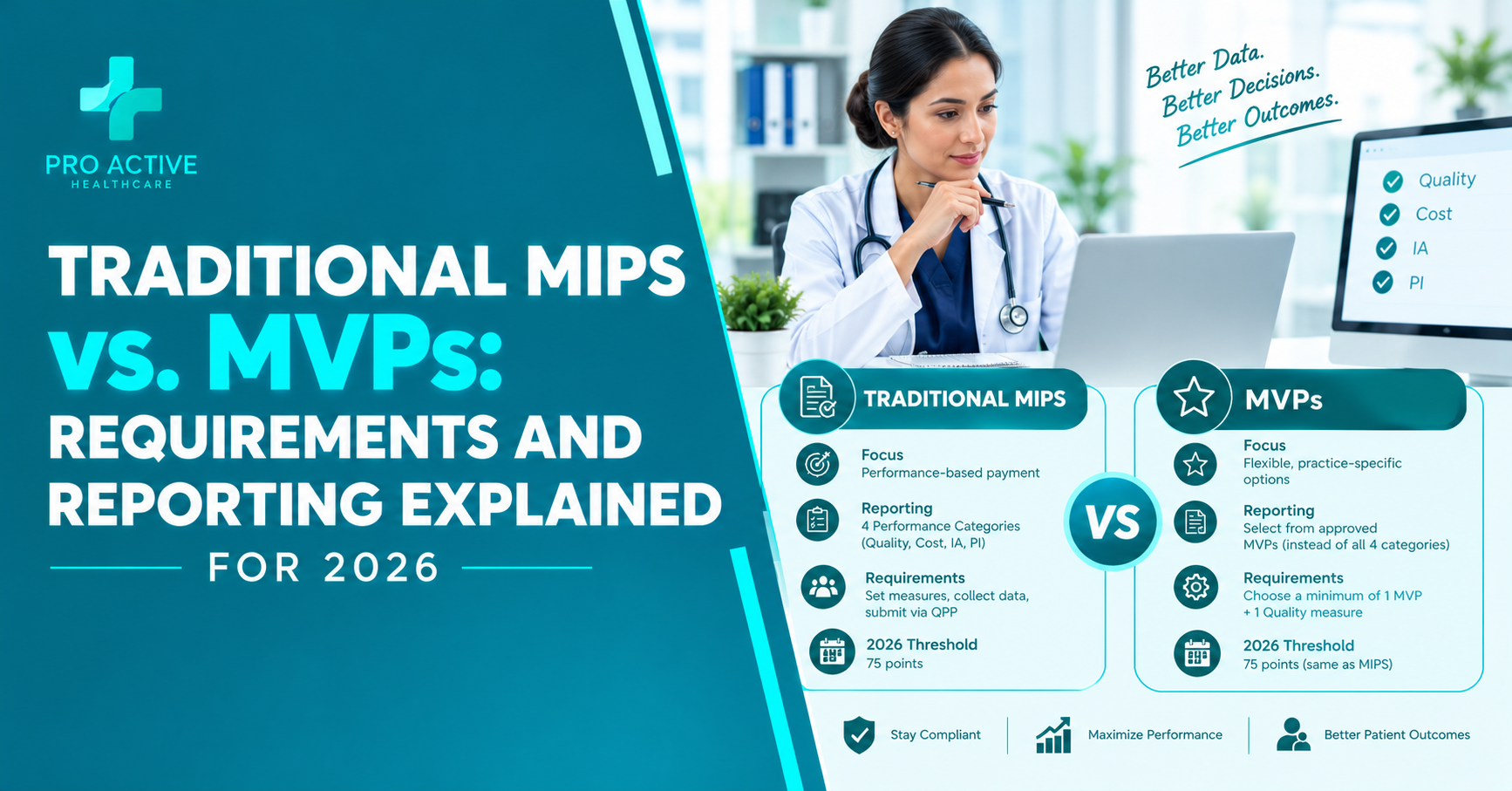
Healthcare providers participating in Medicare’s Quality Payment Program (QPP) must understand their reporting options to manage compliance, monitor performance, and prepare for potential payment adjustments. One of the most important decisions is whether to report through MIPS Reporting or a MIPS Value Pathway (MVP).
Traditional MIPS allows eligible clinicians to select measures and improvement activities from the broader CMS inventory, while MVPs organize reporting around a specific specialty, condition, or clinical focus. Both options remain available for the 2026 performance year, depending on eligibility. The Centers for Medicare & Medicaid Services (CMS) has proposed ending Traditional MIPS after the 2028 performance year, but that proposal should not be treated as a finalized requirement.
For physicians, practice administrators, and healthcare compliance managers, choosing the appropriate reporting approach involves more than comparing the number of measures. Practices must evaluate eligibility, clinical workflows, electronic health record (EHR) capabilities, documentation quality, registration deadlines, and available reporting resources.
Proactive Healthcare Services supports healthcare practices with MIPS 2026 Reporting services, reporting-option evaluation, and workflows aligned with their operational needs. Practices should use current CMS guidance as the controlling source for program requirements.
Traditional MIPS vs. MVPs: Key Differences at a Glance
The main difference between Traditional MIPS and MVPs is how CMS organizes performance reporting. Traditional MIPS provides broader flexibility in measure selection, whereas MVPs use a more focused collection of measures and activities connected to a clinical specialty or condition.
| Reporting Feature | Traditional MIPS | MIPS Value Pathways |
| Quality measures | Generally six measures | Four measures from the selected pathway |
| Improvement Activities | Choose activities under applicable reporting rules (often two medium-weighted activities or one high-weighted activity) | One activity from the pathway’s approved list |
| Promoting Interoperability | Applicable full measure set | Generally the same requirements, subject to exceptions and reweighting |
| Cost | Calculated by CMS using claims data | Calculated by CMS using pathway-related cost measures |
| Population health | Applied where relevant | Incorporated into Quality when applicable requirements are met |
| Measure selection | Broader CMS measure inventory | Specialty or condition-focused measure set |
| Registration | No separate MVP registration | Advance registration required |
| Reporting flexibility | Greater flexibility in selecting measures | More structured reporting framework |
Specific requirements may vary according to clinician eligibility, practice size, reporting method, special status, and the selected pathway. Practices should confirm the applicable performance-year requirements using the official Quality Payment Program website.
What Is Traditional MIPS Reporting?
The Merit-based Incentive Payment System (MIPS) is a Medicare performance program that evaluates eligible clinicians across defined performance categories. Traditional MIPS is the established reporting option within this framework. For a detailed walkthrough of how it works, see this guide to Traditional MIPS reporting.
For the 2026 performance year, the four standard performance categories are:
- • Quality: Measures the quality of care delivered to patients.
- • Cost: Evaluates Medicare spending associated with applicable services and episodes of care.
- • Improvement Activities: Assesses participation in activities designed to improve clinical practice and care delivery.
- • Promoting Interoperability: Evaluates applicable use of certified electronic health record technology and related requirements.
For 2026, the standard category weights are 30% for Quality, 30% for Cost, 15% for Improvement Activities, and 25% for Promoting Interoperability. Special statuses and applicable exceptions may change how categories are weighted.
The performance threshold is 75 points. A clinician’s final score determines whether the applicable MIPS payment adjustment is negative, neutral, or positive under the program’s payment rules. Practices that want to avoid MIPS penalties in 2026 should track their progress toward this threshold throughout the year. A particular score or adjustment is not guaranteed by selecting a specific reporting method.
Advantages and Challenges of Traditional MIPS
Traditional MIPS offers flexibility because practices can select quality measures that better reflect their services, patient populations, and available clinical data. This can be useful for multispecialty organizations or clinicians whose work does not align neatly with a single MVP.
However, the broad selection of measures can create additional administrative work. Teams must determine which measures are appropriate, establish reliable data collection processes, monitor completeness, and maintain documentation that supports reported results.
For example, a practice may select a measure that appears relevant to its specialty but later discover that its EHR does not capture all the required data elements. Without early validation, the practice could face reporting gaps that are difficult to correct before submission.
PHCS supports Traditional MIPS Reporting through eligibility assessment, measure selection, data collection and validation, performance monitoring, and submission preparation. These services can help practices establish a more organized reporting process while retaining responsibility for clinical accuracy and applicable program requirements.
What Are MIPS Value Pathways?
MIPS Value Pathways are an alternative reporting approach developed by CMS to connect quality measures, cost measures, and improvement activities around a specific specialty, condition, or clinical focus.
Instead of selecting from the broader Traditional MIPS inventory, participating clinicians report through a defined pathway with its own requirements. The goal is to make performance assessment more clinically meaningful and provide more relevant comparisons between clinicians reporting through similar pathways.
For the 2026 performance year, CMS finalized 27 MVPs, including six new pathways covering diagnostic radiology, interventional radiology, neuropsychology, pathology, podiatry, and vascular surgery. Practices should consult the official CMS MVP resources to confirm the pathways and measures applicable to their specialty.
How MVP Reporting Works
Although requirements differ by pathway, the general reporting structure includes the following elements:
- • Quality measures: Participants generally report four measures from the selected MVP, including an outcome measure when required and available under the applicable rules.
- • Improvement Activities: Participants select one activity from the pathway’s approved list.
- • Promoting Interoperability: Applicable requirements generally remain similar to Traditional MIPS, subject to relevant exceptions and reweighting policies.
- • Cost measures: CMS calculates applicable cost performance using Medicare claims data. Participants do not independently select the cost measures used for their assessment.
- • Registration: Clinicians or groups must complete the required MVP registration before the deadline. Group participation and subgroup requirements depend on the reporting arrangement.
MVPs can make measure selection more focused, but they do not eliminate the need for documentation, data validation, performance monitoring, or compliance oversight.
Why Is CMS Moving Toward MVP Reporting?
The MVP framework is intended to create a more connected view of healthcare performance. When quality measures, cost measures, and improvement activities reflect a common clinical focus, providers may find it easier to understand how their performance compares with similar practices. This is one reason why healthcare providers are choosing MIPS Value Pathways.
A focused reporting structure can also help healthcare organizations identify meaningful improvement opportunities. Rather than managing a disconnected collection of measures, teams can assess performance within a more coherent clinical framework.
However, the benefits depend on the pathway selected and the practice’s ability to report its measures accurately. A pathway with limited relevance to a practice’s patient population may be less suitable than a broader reporting option.
CMS’s CY 2027 Physician Fee Schedule proposed rule includes a proposal to sunset Traditional MIPS after the 2028 performance year and transition eligible clinicians toward MVP reporting beginning with the 2029 performance period, subject to applicable exceptions and the APM Performance Pathway. This remains a proposal, not a finalized requirement. Practices should verify the final rule before making long-term compliance decisions.
Which Reporting Option Is Better for Your Practice?
There is no universally correct choice between Traditional MIPS and MVPs. The appropriate option depends on eligibility, specialty alignment, available data, organizational structure, and reporting capacity.
1. Confirm MIPS Eligibility First
Before choosing a reporting method, verify whether each clinician is required to participate in MIPS.
Eligibility can differ among clinicians within the same organization. Check the clinician’s National Provider Identifier (NPI) using the QPP Participation Status Tool and confirm the applicable performance year.
Also determine whether the clinician has a special status, qualifies for an exemption, or has an applicable alternative participation route.
2. Evaluate Specialty and Measure Alignment
Review the services your practice actually provides rather than relying exclusively on its specialty label.
Compare the MVP’s quality measures and improvement activities with your patient population, clinical workflows, and documentation practices. Confirm that the required measures can be reported using the data available to your team.
If the available pathway does not fit your services or cannot be supported with reliable data, Traditional MIPS may be more practical for the 2026 performance year.
3. Assess EHR and Data Readiness
Your EHR, registry, or qualified clinical data registry (QCDR) can influence which reporting options are feasible.
Ask your technology or registry vendor whether the specific pathway and measures are supported. Confirm data extraction requirements, reporting formats, completeness expectations, and any limitations that could affect submission.
Do not wait until the end of the performance year to identify missing data. Periodic validation allows practices to identify documentation gaps, correct workflow problems, and address measure-specific issues while there is still time to respond.
4. Consider Staffing and Administrative Capacity
A smaller measure set does not automatically mean less work. MVP participants must still meet registration requirements, document improvement activities, validate data, and complete applicable Promoting Interoperability requirements.
Consider who will monitor each measure, maintain supporting evidence, communicate with the EHR vendor, and coordinate the submission process. Assigning clear responsibilities can help reduce avoidable errors.
5. Understand Group and Subgroup Requirements
Multispecialty organizations may face additional planning requirements when considering MVP reporting. Depending on CMS rules, group participation may be restricted to certain organizational arrangements, while other multispecialty practices may need to report through subgroups or individual clinicians.
Confirm the permitted reporting arrangement before registration. Choosing a pathway without understanding the group structure can create administrative complications later.
Important MIPS and MVP Deadlines for 2026
Deadline management is essential because reporting options do not always have the same registration requirements.
According to the official QPP timeline, the following dates apply to the 2026 performance year. The dates below refer to the general CMS program timeline; practices should also check any registry- or vendor-specific deadlines:
- • June 30, 2026, at 8:00 p.m. ET: Deadline to register for the CAHPS for MIPS Survey. If a practice intends to use the survey as part of an MVP, it must also complete the associated MVP registration by this earlier deadline.
- • November 30, 2026, at 8:00 p.m. ET: General deadline for MVP registration, except where an earlier deadline applies because of CAHPS for MIPS Survey participation.
- • December 31, 2026, at 8:00 p.m. ET: Deadline for applicable 2026 MIPS exception applications.
- • January 4, 2027: MIPS data submission window opens.
- • March 31, 2027: MIPS data submission window closes.
The CAHPS for MIPS Survey has a separate registration requirement. If a practice intends to use the survey as one of its MVP quality measures, it must complete both the MVP registration and the separate CAHPS survey registration by June 30, 2026. This earlier deadline has passed for the 2026 performance year.
Traditional MIPS does not require the separate MVP registration step. However, practices should not assume that every other reporting requirement or exception deadline is the same.
Check the official QPP timeline before acting, as CMS guidance and instructions can change.
Where to Verify Current MIPS Reporting Requirements
MIPS reporting requirements, registration periods, and submission procedures can vary by performance year and reporting option. Healthcare practices should verify the applicable requirements before selecting a reporting strategy or preparing a submission.
The Centers for Medicare & Medicaid Services (CMS) provides official guidance through its Quality Payment Program website. Practices can review current MIPS participation requirements, explore available MIPS Value Pathways, and confirm reporting instructions for the relevant performance year.
Proactive Healthcare Services helps healthcare practices review their reporting requirements, evaluate available options, and organize their MIPS reporting process based on applicable CMS guidance.
How to Prepare Your Practice for MIPS Reporting
Preparing for MIPS reporting requires consistent planning throughout the performance year, not just at submission time. Healthcare practices that establish clear workflows can identify documentation gaps earlier, monitor quality measures more effectively, and reduce avoidable reporting errors. Reviewing the top strategies to succeed under MIPS in 2026 can help your team build a practical plan.
Start by assigning responsibility for each applicable performance category. Physicians, practice administrators, billing teams, and compliance staff should understand their roles in collecting data, maintaining records, and reviewing performance.
Next, evaluate whether your electronic health record (EHR) system captures the information required for your selected quality measures. Review data completeness regularly and address gaps before they affect reporting accuracy. Practices considering MIPS Value Pathways should also confirm that their systems support the measures included in the selected pathway.
Finally, maintain organized documentation of improvement activities and review applicable CMS guidance whenever reporting requirements change. Working with one of the best MIPS consulting services in the USA, such as Proactive Healthcare Services, can help practices evaluate their reporting approach, identify workflow weaknesses, and develop a more structured compliance process.
A proactive approach allows healthcare organizations to make informed reporting decisions while keeping documentation, data quality, and performance improvement aligned with their operational goals.
Common Mistakes to Avoid When Selecting a MIPS Reporting Option
Several preventable problems can undermine an otherwise reasonable reporting strategy.
- • Assuming all clinicians have identical eligibility: Participation requirements should be checked for each clinician and applicable reporting arrangement.
- • Selecting an MVP based only on its name: Review the actual measures, activities, and reporting requirements before deciding that a pathway is suitable.
- • Underestimating data collection: A smaller measure set still requires accurate records, complete data, and evidence supporting reported performance.
- • Ignoring registration deadlines: Missing the MVP registration deadline can prevent participation through that pathway for the performance year.
- • Relying on outdated guidance: Requirements and available pathways can change between performance years. Confirm current CMS guidance instead of reusing last year’s reporting plan without review.
- • Waiting until submission to validate results: Late discovery of missing documentation or incompatible data can limit opportunities to correct errors.
Neither Traditional MIPS nor MVP participation guarantees a particular performance score, Medicare payment adjustment, or compliance outcome. Strong results depend on applicable requirements, data quality, documentation, and consistent implementation.
How Proactive Healthcare Services Supports MIPS Reporting
Choosing between Traditional MIPS and MVPs is easier when practices evaluate the decision using a structured process rather than treating it as a last-minute administrative task.
Proactive Healthcare Services provides healthcare compliance and reporting support for providers across the United States. Its services can help practices assess reporting requirements, evaluate measure suitability, organize performance data, and prepare for applicable submission deadlines.
Support can include:
- • MIPS eligibility assessment and reporting strategy development.
- • Traditional MIPS measure selection and performance tracking.
- • MVP pathway evaluation and measure mapping.
- • Data collection, completeness checks, and documentation review.
- • Submission preparation and ongoing performance monitoring.
For practices considering a transition to MVP reporting, early preparation can help identify data limitations, clarify staff responsibilities, and evaluate whether the selected pathway reflects actual clinical services.
PHCS also provides MIPS Value Pathways services for organizations seeking more focused reporting support. The appropriate service depends on the practice’s eligibility, reporting arrangement, specialty, and operational needs.
The objective is to help healthcare teams manage reporting requirements with greater clarity while supporting accurate documentation and informed performance improvement decisions.
Frequently Asked Questions
Q1- What is the difference between Traditional MIPS and MVPs?
Traditional MIPS allows eligible clinicians to select measures and improvement activities from the broader CMS inventory. MVPs use a more focused set of measures and activities organized around a specialty, condition, or clinical focus.
Q2- Is Traditional MIPS still available in 2026?
Yes. Traditional MIPS remains available for the 2026 performance year, subject to eligibility. CMS has proposed ending Traditional MIPS after the 2028 performance year, but the proposed change should not be treated as final until confirmed by an official final rule.
Q3- How many quality measures are required for Traditional MIPS and MVPs?
Traditional MIPS generally requires six quality measures. MVP reporting generally requires four measures from the selected pathway, including an outcome measure or an applicable high-priority measure when an outcome measure is unavailable. Confirm the specific requirements for the reporting method and performance year.
Q4- Is MVP reporting mandatory for all eligible clinicians?
No. MVP reporting is an available reporting option for 2026, not a universal requirement for all eligible clinicians. The future reporting framework depends on finalized CMS policy and the clinician’s applicable participation route.
Q5- When does MVP registration close for the 2026 performance year?
The MVP registration deadline is November 30, 2026, at 8:00 p.m. Eastern Time. Practices should confirm the deadline and registration requirements through the official QPP website.
Q6- Can a practice report through Traditional MIPS and an MVP?
CMS guidance states that participants registered for an MVP may report Traditional MIPS instead of, or in addition to, the registered MVP. If they report both Traditional MIPS and an MVP, CMS uses the higher applicable score to determine the final score. The rules differ by participation arrangement, so practices should confirm their specific circumstances in the QPP guidance before proceeding.
Q7- How can a practice determine whether an MVP is suitable?
Review the pathway’s approved measures and improvement activities, compare them with the practice’s patient population and services, and confirm that the EHR or registry can support the required data. Eligibility, group structure, registration, and staffing capacity should also be evaluated.
Conclusion
The decision between Traditional MIPS and MVPs should reflect your practice’s reporting needs, clinical focus, data readiness, and administrative resources. Traditional MIPS offers broader flexibility, while MVPs provide a more structured approach to specialty-focused performance reporting.
For the 2026 performance year, both options remain available, subject to eligibility and applicable CMS requirements. With the proposed future transition still requiring confirmation through final rulemaking, practices should make decisions based on current requirements while preparing for potential changes.
Proactive Healthcare Services can help healthcare providers evaluate MIPS reporting options, organize documentation, review performance data, and plan for upcoming deadlines. A well-prepared reporting strategy can help practices approach compliance with greater confidence and make more informed decisions about performance improvement.
To discuss your reporting requirements, explore PHCS’s Traditional MIPS Reporting or MIPS Value Pathways services.