
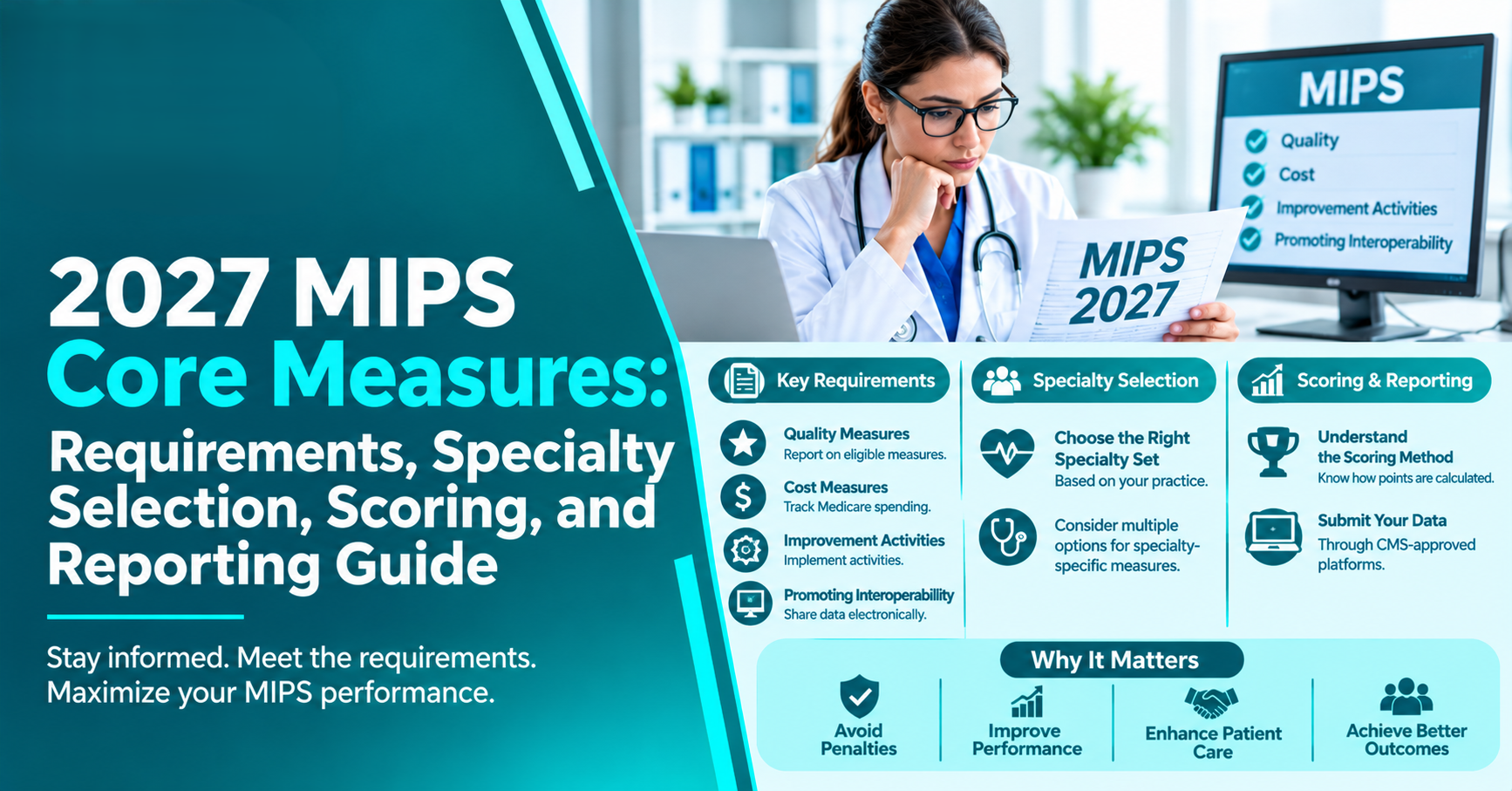
The 2027 MIPS Core Measure requirement introduces an important change to how eligible clinicians select and report quality measures under Medicare’s Quality Payment Program (QPP). Beginning with the 2027 performance year, clinicians must report at least one applicable, CMS-designated MIPS Core Measure as part of their Quality performance category submission. This replaces the previous requirement to report at least one outcome measure or, when an outcome measure is unavailable, a high-priority measure.
For physicians and healthcare practices, the change means that choosing quality measures will require closer attention to specialty, clinical services, patient populations, and reporting capabilities. A measure that works for a primary care practice may not be appropriate for a cardiology, orthopedic, pathology, or pain management practice.
CMS finalized this policy in the Calendar Year 2027 Medicare Physician Fee Schedule Final Rule (CMS-1848-F), released on November 4, 2026. The final rule also introduces three new MIPS Value Pathways (MVPs) focused on diabetes, hypertension, and hospitalists.
This guide explains how the 2027 MIPS Core Measures work, which practices must report them, how to identify an applicable measure, and what healthcare organizations should do to prepare for the reporting period. It also explains the relationship between Core Measures, traditional MIPS, and MIPS Value Pathways reporting so practices can make informed decisions about their Medicare quality reporting strategy.
What Are MIPS Core Measures?
MIPS Core Measures are CMS-designated Quality measures that focus on important aspects of clinical care within particular specialties, medical conditions, and patient populations.
They are intended to make quality reporting more relevant to the services clinicians provide. Rather than relying only on the broader requirement to report an outcome or high-priority measure, CMS now requires eligible clinicians to include at least one designated Core Measure in their quality reporting submission, subject to applicable exemptions and attestation provisions.
Core Measures are part of the existing MIPS Quality performance category. They do not create another performance category or replace the entire quality measure inventory.
For example, a cardiology practice should evaluate measures that reflect cardiovascular care, while an orthopedic practice should consider measures relevant to musculoskeletal conditions and the services it provides. The actual selection must follow CMS’s designated measure inventory and individual measure specifications.
It is important to understand the difference between three commonly confused terms:
- · MIPS Quality Measures: The broader collection of clinical quality measures available for MIPS reporting.
- · MIPS Core Measures: A designated subset of MIPS Quality measures that clinicians must consider when meeting the new reporting requirement.
- · Core Quality Measures Collaborative (CQMC) Measures: Measure sets developed through a separate multi-stakeholder initiative. These are not automatically equivalent to CMS-designated MIPS Core Measures.
A measure should only be treated as a MIPS Core Measure when it carries the appropriate CMS designation for the applicable performance year.
What Changed in the 2027 MIPS Core Measure Requirements?
The most important change is the replacement of the previous outcome or high-priority measure requirement with a designated Core Measure requirement.
Previously, clinicians reporting through traditional MIPS generally needed to include at least one outcome measure in their Quality submission. When an applicable outcome measure was unavailable, a high-priority measure could satisfy the requirement.
Beginning with the 2027 performance year, clinicians must instead report at least one applicable MIPS Core Measure.
The requirement applies to both traditional MIPS and MIPS Value Pathways. However, CMS also provides an exemption for qualifying small practices and an attestation option for eligible reporting participants who do not have an applicable Core Measure.
The following table summarizes the important policy changes.
| Reporting area | 2027 policy |
| Core Measure requirement | At least one applicable Core Measure |
| Traditional MIPS | One Core Measure within the existing six-measure Quality submission |
| MVP reporting | One Core Measure within the existing four-measure Quality submission |
| Previous outcome requirement | Replaced by the Core Measure requirement |
| Previous high-priority requirement | Replaced by the Core Measure requirement |
| Small practices | Exempt from the Core Measure requirement |
| No applicable Core Measure | Attestation option for eligible non-exempt participants |
| Performance threshold | 75 points |
The six-measure and four-measure reporting structures remain important when planning a submission. The Core Measure counts within the existing Quality measure selection rather than creating an additional measure requirement.
CMS has also finalized changes to the broader QPP framework, including the transition from traditional MIPS to MVP reporting beginning with the 2031 performance year.
Who Must Report a MIPS Core Measure in 2027?
The requirement affects eligible clinicians and reporting entities participating in MIPS through traditional MIPS or an MVP, subject to the applicable exemptions.
The first step is to determine the clinician’s reporting status. A practice should not assume that every physician within its organization has identical MIPS reporting obligations.
Individual clinicians, group practices, virtual groups, subgroups, and APM Entities may have different reporting arrangements. Their participation status and applicable reporting requirements should be reviewed before selecting measures.
Small Practice Exemption
CMS defines a small practice as a practice with 15 or fewer clinicians, identified by their National Provider Identifiers (NPIs), who have reassigned their billing rights to a single Taxpayer Identification Number (TIN).
For the 2027 Core Measure requirement, qualifying small practices are exempt. They do not need to report a Core Measure or complete the no-applicable-Core-Measure attestation.
This distinction matters because small practice status is determined using CMS’s definition, not simply the number of employees working in an office.
For example, a medical group may employ several administrative and billing professionals but have fewer than 15 clinicians associated with its TIN. Its eligibility for the exemption must be evaluated using the applicable CMS definition.
Practices should verify their reporting arrangement rather than automatically assuming that a small office qualifies.
What If No Core Measure Applies to a Practice?
Some clinicians may provide services that are not adequately represented by the available Core Measure inventory.
CMS provides an attestation pathway for eligible participants who do not have an applicable Core Measure. These participants must follow the applicable reporting and submission instructions and select another eligible Quality measure in place of the Core Measure.
This provision is particularly relevant to specialized practices with limited measure availability.
For example, a physician may provide a highly specialized service, but the available Core Measures may not reflect the patients treated or the clinical work performed. In that situation, the practice should review the official specifications, establish why the available measures do not apply, and follow CMS’s attestation process.
An attestation should reflect an actual review of measure applicability. It should not be used simply because another measure appears easier to report.
How to Identify the Right 2027 MIPS Core Measure
Selecting a Core Measure requires more than matching a physician’s specialty name to a measure title. Practices must determine whether the measure applies to their clinical services, eligible patients, reporting arrangement, and data collection capabilities.
The official QPP Resource Library and CMS measure specifications should be the starting points for this process.
A practical selection process includes the following steps.
1. Confirm MIPS Participation and Reporting Level
Determine whether each clinician is required to participate in MIPS and whether reporting will occur individually, as a group, through a virtual group, or through an MVP.
This is important because the applicable reporting structure affects measure selection, data collection, and submission responsibilities.
Use the QPP Participation Lookup to review participation status.
2. Review the Official Core Measure Designation
Open the 2027 Quality measure inventory and identify the measures carrying the CMS Core Measure designation.
Do not assume that a measure qualifies simply because it appears in a specialty measure set or was previously classified as an outcome or high-priority measure.
The designation and applicable performance-year specifications must be checked.
3. Compare Measures With Clinical Services
Review the services clinicians actually provide, the conditions they treat, and the patient populations they manage.
For example, a cardiologist treating patients with cardiovascular conditions should evaluate applicable cardiovascular quality measures. An orthopedic surgeon should examine measures relevant to the procedures and musculoskeletal conditions managed by the practice.
The specialty label alone does not establish measure applicability.
4. Review Denominator and Numerator Requirements
Every quality measure has specific reporting criteria.
The denominator identifies the eligible patient population or qualifying encounters. The numerator identifies the clinical action, outcome, or documentation requirement that must be met.
Practices should also review exclusions, exceptions, reporting periods, and minimum case requirements where applicable.
A measure may appear appropriate but have limited reporting value if very few patients meet its denominator criteria.
5. Confirm Data Collection Capabilities
Before choosing a measure, confirm that the EHR, qualified registry, or other approved reporting system can capture the required information.
For instance, if a measure requires documented clinical findings, the practice should verify that the information is recorded in the appropriate structured fields rather than relying entirely on unstructured notes.
The selected measure must also be compatible with an eligible collection type.
6. Establish a Reporting Owner
Assign responsibility for collecting data, reviewing specifications, identifying documentation gaps, and validating the final submission.
Clinical teams should remain responsible for accurate patient care documentation, while reporting and compliance teams can coordinate data review and submission preparation.
This separation helps prevent missing information and inconsistent reporting practices.
Specialty-Specific Considerations for MIPS Core Measures
Core Measure selection is particularly important for specialty practices because their patient populations and clinical workflows differ considerably.
A primary care physician, cardiologist, orthopedic surgeon, and pain management specialist may all participate in MIPS, but the same measure will not necessarily be appropriate for all four.
The following examples illustrate how specialty practices should approach the selection process.
Cardiology
Cardiology practices should review measures related to cardiovascular disease management, heart failure, blood pressure control, and other applicable aspects of cardiac care.
The selection process should consider the services provided, eligible patient population, and whether the practice can consistently capture the required clinical information.
For example, a cardiology practice treating patients with heart failure should review applicable heart failure measures and determine whether its clinical documentation and reporting system support their specifications.
Proactive Healthcare Services provides additional guidance through its Cardiology MIPS Reporting resource.
Orthopedic Surgery
Orthopedic practices should examine measures associated with joint procedures, musculoskeletal conditions, functional outcomes, and postoperative care where applicable.
A measure should be selected based on its actual denominator requirements and the clinical services provided by the participating clinicians.
Practices should also evaluate whether patient-reported information and functional assessments are captured consistently when required by a measure.
Explore our Orthopedic Surgery MIPS Reporting guide for additional specialty-specific reporting considerations.
Pain Management
Pain management clinicians should evaluate measures relevant to functional status, treatment planning, patient assessment, and other applicable aspects of pain care.
The practice should establish whether its patient encounters meet the measure specifications and whether the necessary documentation can be captured throughout the performance period.
A measure should not be selected solely because it appears in a general quality inventory.
Read our Pain Management MIPS Reporting guide for more information.
Pathology
Pathology provides a useful example of how Core Measures can address specialty-specific reporting needs.
The College of American Pathologists identifies the following measures as pathology Core Measures for the 2027 performance year:
- · Quality ID 396: Lung Cancer Reporting (Resection Specimens).
- · Quality ID 440: Skin Cancer: Biopsy Reporting Time, Pathologist to Clinician.
- · Quality ID 491: Mismatch Repair (MMR) or Microsatellite Instability (MSI) Biomarker Testing Status in Colorectal Carcinoma, Endometrial, Gastroesophageal, or Small Bowel Carcinoma.
These examples demonstrate why practices should review specialty-specific measure specifications rather than relying on general measure descriptions.
Pathology practices that cannot report an applicable Core Measure should follow the applicable CMS attestation instructions, unless they qualify for the small practice exemption.
How MIPS Core Measures Affect Quality Scoring
Core Measures are part of the Quality performance category, so their reporting can influence a clinician’s overall MIPS performance.
Under the standard traditional MIPS scoring structure, the Quality performance category generally contributes 30% of the final MIPS score. However, applicable category reweighting and program-specific scoring provisions can affect the final calculation. The overall performance threshold remains 75 points for the 2027 performance year.
However, reporting a Core Measure does not automatically guarantee a high Quality score.
The actual score depends on applicable measure specifications, performance results, data completeness, benchmarks, and other CMS scoring requirements.
Performance Threshold
CMS has maintained the 75-point MIPS performance threshold for 2027.
Clinicians should therefore evaluate their reporting strategy across all applicable performance categories rather than focusing exclusively on the new Core Measure requirement.
Data Completeness
Data completeness remains an important part of Quality reporting.
For applicable MIPS Quality measures, clinicians generally must submit data covering at least 75% of denominator-eligible patients or instances, regardless of payer, when the applicable collection type uses this requirement. Claims-based measures follow their own applicable-patient reporting criteria. Practices should review the specifications for each measure and reporting method before determining their data collection obligations.
The precise requirements depend on the collection type and measure specifications.
Missing clinical information, inconsistent documentation, and incomplete patient records can affect reporting results even when a practice has selected an appropriate measure.
Measure Benchmarks
CMS uses measure-specific benchmarks to evaluate performance and award achievement points.
Practices should review available benchmarks before making final measure selections. Historical performance, reporting method, and eligible case volume can all affect the usefulness of a measure for performance planning.
CMS also finalized special scoring provisions for certain topped-out measures. Practices should consult the applicable 2027 scoring guidance rather than assuming that every measure follows an identical scoring structure.
The important distinction is that Core Measure compliance and actual quality performance are related but separate considerations. Meeting the reporting requirement does not guarantee a particular score or Medicare payment adjustment.
Traditional MIPS vs. MVP Reporting: What Changes in 2027?
CMS is continuing its transition toward specialty-focused MIPS Value Pathways.
Traditional MIPS and MVPs remain available reporting options for the 2027 performance year, but both now include the Core Measure requirement.
Traditional MIPS allows clinicians to select measures from the broader Quality inventory. MVP reporting organizes relevant measures and activities around a particular clinical area or specialty.
| Reporting consideration | Traditional MIPS | MVP |
| Quality measure selection | Broader Quality inventory | Measures within the selected pathway |
| Quality measure requirement | Generally six measures | Generally four measures |
| Core Measure | At least one applicable measure | At least one applicable measure |
| Clinical focus | Broader reporting framework | Specialty or condition-focused framework |
| Reporting preparation | Review individual measure specifications | Review pathway and measure specifications |
CMS has finalized three new MVPs for 2027, focusing on diabetes, hypertension, and hospitalists.
CMS has finalized the transition from traditional MIPS to MIPS Value Pathways. Traditional MIPS will remain available through the 2030 performance year and will officially sunset beginning with the 2031 performance year. After the transition, MVPs will become the standard MIPS reporting option for eligible clinicians who are not eligible to report through the Alternative Payment Model Performance Pathway (APP). Practices should use the transition period to evaluate applicable MVPs, review reporting requirements, and prepare their clinical data collection workflows.
This gives eligible clinicians additional time to evaluate MVP participation and prepare their reporting systems.
Practices considering the transition should review our resources on MIPS Value Pathways and Traditional MIPS vs. MVPs.
Documentation and Data Management for Core Measure Reporting
Accurate documentation is essential for successful MIPS quality reporting.
A practice may select an appropriate Core Measure but still experience reporting problems if clinical records do not support the required numerator and denominator information.
Documentation workflows should therefore be reviewed before and throughout the performance year.
Healthcare practices should maintain:
Clinical documentation: Patient records should accurately reflect the services provided, relevant clinical findings, and treatment decisions.
Structured EHR information: Required clinical information should be entered into appropriate fields so that reporting systems can identify eligible cases and measure performance.
Denominator and exclusion records: Practices should retain information supporting patient eligibility, exclusions, and applicable exceptions.
Data validation records: Periodic reviews should identify missing information, inconsistent entries, and discrepancies between clinical records and reporting data.
Measure selection documentation: Practices should maintain a record explaining why a particular Core Measure was selected and how its specifications were evaluated.
Submission confirmation: Reporting teams should retain relevant submission records and supporting documentation in accordance with applicable CMS requirements and organizational retention policies.
An important operational consideration is the relationship between clinical documentation and medical billing.
Claims information may support certain administrative claims-based measures and other reporting processes. However, not every MIPS Quality measure is calculated from claims. Some require clinical data submitted through an approved reporting method.
Practices should therefore avoid treating billing records as a complete replacement for clinical quality data.
Accurate medical billing services and appropriate coding processes can support reliable healthcare administration, but clinical quality reporting must follow the specifications of each individual measure.
Common Mistakes to Avoid When Reporting MIPS Core Measures
Several reporting mistakes can create unnecessary compliance risks and reduce the reliability of quality submissions.
Selecting a measure without checking its CMS designation
A measure’s appearance in the general Quality inventory does not make it a Core Measure. Verify the official 2027 designation.
Choosing measures based only on specialty names
A measure must apply to the clinician’s actual services and eligible patient population. Specialty alignment alone is not sufficient.
Ignoring denominator requirements
Practices should examine eligible patient criteria, exclusions, and minimum case requirements before committing to a measure.
Assuming small practice exemption without verification
The CMS definition is based on clinician NPIs associated with a single TIN, not simply the number of employees.
Using attestation without reviewing measure applicability
An attestation should be supported by an appropriate review of the available measures and the clinician’s reporting circumstances.
Waiting until the submission deadline
Missing information is more difficult to correct when identified near the end of the reporting period. Regular monitoring is a better approach.
Confusing Core Measure compliance with a high performance score
Reporting a required measure satisfies a reporting obligation, but the actual Quality score depends on performance and applicable scoring rules.
How Healthcare Practices Can Prepare for 2027 MIPS Reporting
Preparing for the 2027 performance year should involve clinical, administrative, and reporting teams.
Rather than treating the new Core Measure requirement as an isolated submission task, practices should incorporate it into their broader MIPS reporting workflow.
The following preparation process can help:
- Verify MIPS eligibility using the CMS participation lookup.
- Confirm the reporting arrangement for each eligible clinician.
- Determine whether the practice qualifies for the small practice exemption.
- Review the finalized 2027 Core Measure designation.
- Match available measures with clinical services and patient populations.
- Review numerator, denominator, exclusion, and collection type requirements.
- Confirm that the EHR or registry supports the selected measure.
- Identify documentation gaps before they affect reporting.
- Assign responsibilities to clinical and administrative staff.
- Monitor data completeness and measure performance regularly.
- Review applicable benchmarks and scoring guidance.
- Validate the final submission before the CMS reporting deadline.
Practices should also evaluate whether traditional MIPS or an MVP provides the more appropriate reporting structure for their organization.
This is especially important for groups managing multiple specialties, where individual clinicians may have different measure requirements and clinical workflows.
How Proactive Healthcare Services Supports 2027 MIPS Core Measure Reporting
Preparing for MIPS requires more than submitting quality data at the end of the performance year. Practices need a structured approach to eligibility, measure selection, clinical documentation, data validation, and reporting.
Proactive Healthcare Services supports healthcare providers with MIPS reporting and related healthcare administrative services.
Our reporting support can help practices organize their quality reporting processes, review applicable measure specifications, identify documentation gaps, and prepare their data for submission.
Depending on the practice’s reporting arrangement and service requirements, support may include:
- · MIPS eligibility and reporting arrangement review.
- · Quality measure selection and planning.
- · Core Measure applicability assessment.
- · Clinical documentation review.
- · Quality data collection and validation.
- · Reporting workflow coordination.
- · Preparation for traditional MIPS and MVP reporting.
Our objective is to help healthcare organizations approach Medicare quality reporting with better preparation, organized documentation, and a more consistent reporting process.
Explore Proactive Healthcare Services MIPS Reporting Services to learn how our team can support your practice’s reporting needs.
Frequently Asked Questions About 2027 MIPS Core Measures
1. What are MIPS Core Measures for 2027?
MIPS Core Measures are CMS-designated Quality measures that reflect important aspects of care within particular specialties and clinical areas. Beginning with the 2027 performance year, eligible clinicians must report at least one applicable Core Measure, subject to the relevant exemptions and attestation provisions.
2. Is reporting a Core Measure mandatory for all MIPS participants?
The requirement applies to eligible participants reporting through traditional MIPS and MVPs. However, qualifying small practices with 15 or fewer clinicians are exempt. Participants without an applicable Core Measure can follow the CMS attestation process.
3. How many Core Measures must a clinician report?
At least one applicable Core Measure is required. It counts toward the existing Quality reporting requirement rather than being added as an extra measure.
4. Does the Core Measure requirement apply to traditional MIPS and MVPs?
Yes. CMS finalized the Core Measure requirement for both reporting options beginning with the 2027 performance year.
5. Are small practices exempt from the 2027 Core Measure requirement?
Yes. CMS defines a small practice as one with 15 or fewer clinicians, identified by NPI, who have reassigned their billing rights to a single TIN. Qualifying small practices do not need to report a Core Measure or submit the no-applicable-measure attestation.
6. What happens if no Core Measure applies to a clinician?
Eligible non-exempt participants can use the applicable self-attestation process and report another eligible Quality measure in place of the unavailable Core Measure. They should follow the current CMS submission instructions.
7. Are MIPS Core Measures the same as outcome measures?
No. Outcome measures describe results of patient care, while Core Measures are a CMS-designated category of Quality measures. The new Core Measure requirement replaces the previous outcome or high-priority reporting requirement.
8. How do Core Measures affect MIPS scoring?
Core Measures are included within the Quality performance category. Their scoring depends on applicable reporting requirements, performance benchmarks, data completeness, and the relevant CMS scoring methodology. Reporting a Core Measure does not guarantee a particular score.
9. What is the MIPS performance threshold for 2027?
The finalized performance threshold remains 75 points for the 2027 performance year.
10. Where can healthcare providers find the official Core Measure list?
Providers should use the 2027 QPP Resource Library and the applicable CMS Quality measure specifications. They should confirm the Core Measure designation for the correct performance year before selecting a measure.
11. Can a medical billing or MIPS reporting company help with Core Measure preparation?
Yes. A qualified reporting partner can assist with eligibility review, measure selection, documentation assessment, data validation, and reporting preparation. The healthcare provider remains responsible for accurate clinical documentation and meeting applicable program requirements.
Conclusion
The 2027 MIPS Core Measure requirement makes specialty alignment an important part of Medicare Quality reporting. Clinicians must now consider whether their selected Quality measures include at least one applicable CMS-designated Core Measure, rather than relying on the previous outcome or high-priority measure requirement.
For healthcare practices, preparation should begin with eligibility verification, measure applicability, documentation review, and data collection planning. Small practices should confirm their exemption, while clinicians without an applicable Core Measure should understand the attestation process.
The transition toward MVP reporting also makes 2027 an important time to review long-term MIPS participation strategies.
Proactive Healthcare Services encourages healthcare providers to approach quality reporting as an ongoing practice management responsibility rather than a year-end administrative task.
For more guidance, read our 2027 MIPS Reporting Requirements guide or explore Proactive Healthcare Services MIPS Reporting Services.