

| A line by line method for decoding PR adjustments on EOBs, remittance advices, and ERAs |
Reading patient responsibility codes on an EOB comes down to one question: of the money the payer did not pay, how much belongs to the patient and why? The answer is spread across columns, codes, and remarks, and the layout changes from payer to payer. A biller who reads the page in the right order can answer that question in under a minute. A biller who reads it out of order bills the wrong person.
This guide gives you a repeatable reading method, an annotated example with the math worked out, a crosswalk from plain language EOB wording to PR codes, and the traps that cause misreads. If you want the broader map of group codes first, start with the complete understanding of patient responsibility codes.
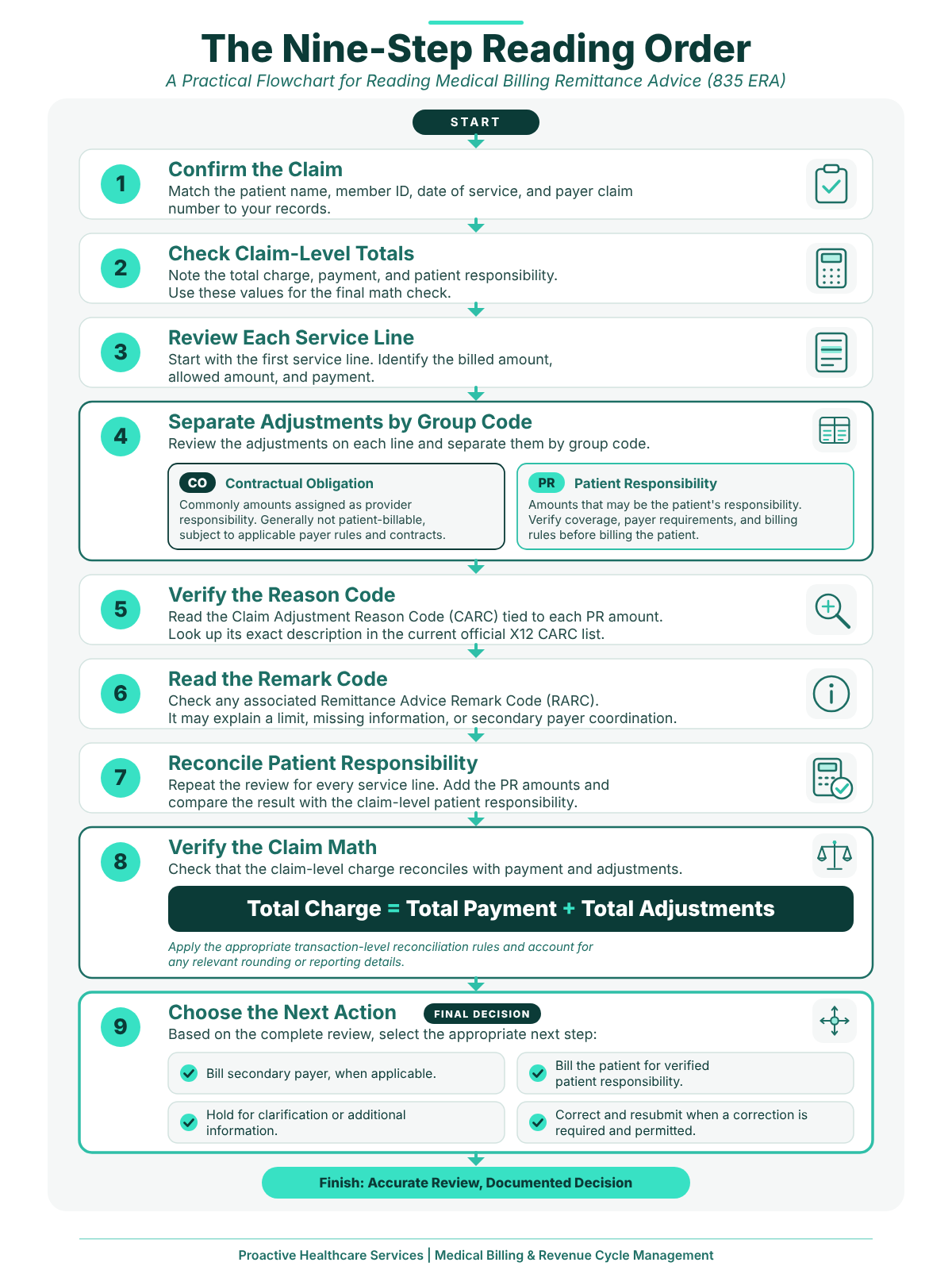
Short answer: find the claim, find each service line, read the group code, then the reason code, then the amount, then any remark. Every PR amount is the patient’s share, or a secondary payer’s, until you prove otherwise. Finish by checking that charges, payment, and adjustments add up.
EOB, EOP, ERA, or MSN: Which Document Are You Reading?
People use “EOB” for several different documents, and the differences affect what you can learn from each one. The Explanation of Benefits that a patient receives is built for a member. The document a provider receives for payment posting is a remittance advice.
| Document | Who receives it | Shows PR codes? | Best use |
| Explanation of Benefits (EOB) | Patient or member | Usually plain language, often no code numbers | Checking what the patient was told and the accumulators they see |
| Explanation of Payment (EOP) or remittance advice | Provider | Yes, as group and reason codes | Payment posting and balance billing |
| Electronic remittance advice (ERA, 835) | Provider or billing system | Yes, in CAS segments | Automated posting and reporting |
| Medicare Summary Notice (MSN) | Original Medicare beneficiary, mailed about every three months | No code numbers; shows amounts the provider may bill | Understanding what the patient sees |
| Medicare remittance advice or standard paper remit | Provider | Yes | Posting Medicare payments and adjustments |
Billers should post from the provider-side document, not from the patient EOB. The patient EOB is still useful when a patient disputes a balance, because it shows what the payer told them they owed. Reviewing the relevant documents helps billers interpret Entity Codes in Medical Billing in context and verify patient responsibility before posting balances.
The Anatomy of a Remittance Page
Whatever the format, a remittance has the same four zones:
- • Header block: payer name, payee, check or electronic payment number, and the payment date.
- • Claim block: patient name, member ID, claim number or control number, dates of service, total charge, total paid, and patient responsibility.
- • Service line block: each procedure with billed amount, allowed amount, adjustments, and payment.
- • Legend block: definitions for reason codes and remark codes used on the page.
The electronic remittance advice reports the total patient responsibility in the CLP segment and lists adjustments in CAS segments. It often reports the allowed amount for each service line in an AMT segment.
The Nine Step Reading Order
Understanding Patient Responsibility Through a Practical Example
Consider a patient who receives an office visit, a chest X-ray, and a lab test under one insurance claim. The health plan includes a $25 office visit copay, 20% coinsurance, and $80 remaining on the patient’s deductible.
For the office visit (CPT 99213), the allowed amount is $110. The insurer applies a $25 copay under PR-3, leaving $85 for the payer to cover. The remaining $65 difference between the billed charge of $175 and the allowed amount is recorded as a contractual adjustment under CO-45.
The chest X-ray (CPT 71046) has an allowed amount of $60. Since the patient’s remaining deductible is $80, the entire $60 is assigned to PR-1 deductible code. The insurer pays nothing toward this service, but that does not mean the claim was denied. The service was processed, and the amount was applied to the deductible.
For the lab test (CPT 85025), the allowed amount is $40. The remaining $20 of the deductible is applied under PR-1. The other $20 is subject to the plan’s 20% coinsurance, resulting in another $4 assigned to PR-2 coinsurance code. The insurer pays the remaining $16, while the $50 difference between the billed and allowed amounts is recorded under CO-45.
Verifying the Claim Totals
The deductible calculation is straightforward: $60 for the chest X-ray plus $20 for the lab test equals the $80 remaining deductible. The patient’s total responsibility is $109, consisting of the $25 copay, $80 deductible, and $4 coinsurance.
The claim also balances: $101 in payer payments, $195 in contractual adjustments, and $109 in patient responsibility equal the total billed charges of $405. These amounts should be reconciled against the claim-level totals on the remittance advice.
How These Adjustments Appear on an 835 ERA
In the electronic remittance advice (835), the lab test’s adjustments use separate CAS segments to record the contractual adjustment and patient responsibility:
CAS*CO*45*50.00~ CAS*PR*1*20.00**2*4.00~
The first segment records the $50 contractual adjustment under CO-45. The second records the $20 deductible under PR-1 and the $4 coinsurance under PR-2. A CAS segment can contain multiple reason-code and amount pairs under the same group code, allowing both patient adjustments to appear in one segment.
This example demonstrates why billers must review each service line, distinguish contractual adjustments from patient responsibility, and reconcile the amounts before posting balances or issuing patient statements.
Translating Plain Language EOB Wording Into PR Codes
Patient EOBs rarely print code numbers. They use wording that you need to map back to the remittance you post from. Layouts vary by payer, so treat this as a starting crosswalk, not a rule.
| What the EOB says | Likely code | What to check |
| Deductible | PR-1 | Amount applied matches the deductible remaining |
| Coinsurance | PR-2 | Percentage times the allowed amount, less any deductible |
| Copay | PR-3 | Compare with what was collected at the visit |
| Provider discount, network savings, or plan discount | CO-45 | This is a write off, not the patient’s balance. |
| Not covered or amount not covered | Varies, such as PR-96, PR-204, or PR-119 | Read the exact reason; the group code can be PR or CO depending on contract and notice |
| Not medically necessary | Often PR-50 or a CO equivalent | Check whether the patient signed advance notice before billing them |
| Coverage not in effect or member not found | Eligibility related, such as PR-26, PR-27, or PR-31 | Verify dates of coverage and subscriber details |
| You may owe, your share, or patient responsibility | Sum of PR amounts | Compare with the claim level total |
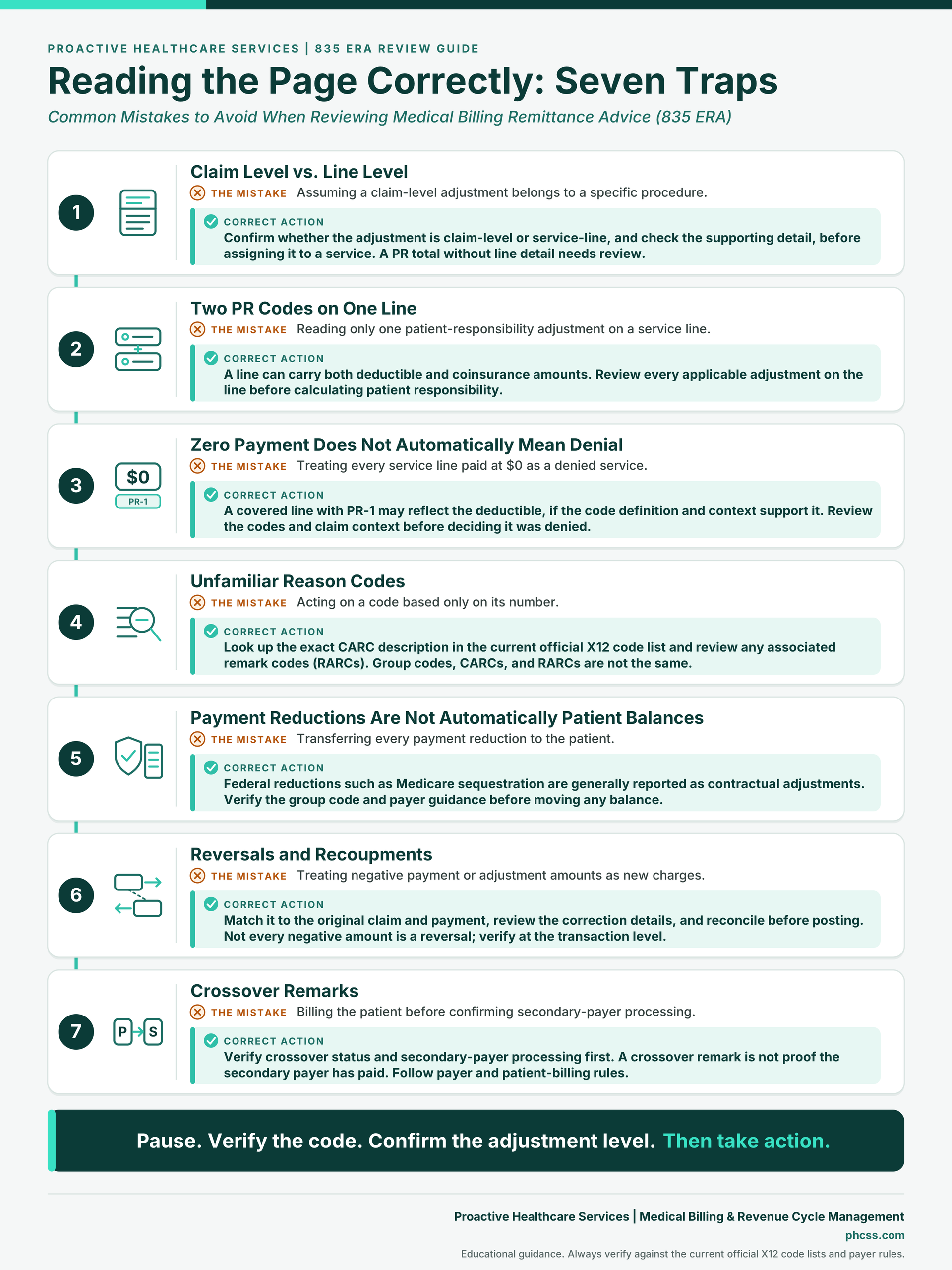
Reading the Page Correctly: Seven Traps
After You Read It: Deciding the Next Action
| What you found | Next action |
| PR amounts match the plan and no other coverage exists | Post to patient responsibility and send a statement |
| Secondary or supplemental coverage exists | Bill the secondary first with the primary adjustments attached |
| PR amount does not match the plan | Gather proof and be careful about Billing Errors |
| PR is attached to a reason that belongs to the provider | Challenge the group code with the payer before billing the patient |
| Claim does not balance | Resolve the difference before posting anything |
Posting Rules That Keep the Page and Your Ledger in Agreement
- • Post the payment first, then each adjustment by group code, so CO amounts are written off and PR amounts transfer to patient balance.
- • Keep the reason code with each posted adjustment so reports can group PR dollars by cause.
- • Reconcile the posted PR total with the claim level patient responsibility before closing the batch.
- • Review auto posting rules regularly. A rule that sends every unfamiliar PR code to patient balance can create wrong statements at scale.
Store the remittance with the account so it can be produced for a dispute or an appeal.
Practices without the staff for this level of detail often use ERA payment posting services for medical practices to keep group codes and balances consistent. At the program level, revenue cycle management services for denial and payment tracking show which PR reasons are driving the most patient balances, and periodic remittance advice audit services for posting accuracy can confirm the posted amounts match the pages.
Payer Differences That Change How You Read
- • Original Medicare: expect the Part B deductible and 20% coinsurance as the main PR reasons, plus crossover remarks when a supplemental plan is on file.
- • Medicare Advantage: expect plan specific copays and coinsurance that do not follow Original Medicare patterns.
- • Commercial plans: expect a wide range of deductible, copay, and coinsurance structures, so rely on the eligibility response for the date of service.
- • Medicaid: remittance layouts vary by state, and cost sharing is usually limited, so verify state rules before billing any PR amount.
How Can PHCS Help You Manage Patient Responsibility Codes?
At Proactive Healthcare Services, we help medical practices accurately manage patient responsibility adjustments through our medical billing services and revenue cycle management services. Our team reviews EOBs and ERAs, checks PR codes against payer adjustments, corrects inaccurate patient balances, and follows up on secondary insurance claims before billing patients. We also help resolve payment posting discrepancies, investigate billing errors, and improve patient collections while maintaining accurate financial records. Contact PHCS to learn how our billing specialists can help your practice reduce errors, prevent revenue leakage, and streamline the payment posting process.
Frequently Asked Questions
Q1- What is the difference between an EOB and a remittance advice?
An EOB goes to the patient in plain language. A remittance advice goes to the provider and carries the group and reason codes needed for posting.
Q2- Where do I find the PR code on a paper EOB?
Look for the adjustment columns or the reason code column beside each service line. Patient EOBs often print only the wording, not the number.
Q3- What does PR mean on a remittance?
It stands for patient responsibility and means the amount can be billed to the patient or to a secondary payer.
Q4- What is the difference between PR and CO on an EOB?
PR amounts belong to the patient or a secondary payer. CO amounts are contractual adjustments the provider writes off.
Q5- Why does the patient responsibility total not match the lines?
Some adjustments may be reported at claim level, or a line may carry a second PR reason you have not added.
Q6- Can a PR amount be wrong?
Yes. Payers can apply outdated accumulators or the wrong plan. Verify before billing.
Q7- What should I check first when posting?
Confirm the claim balances, then compare PR amounts with the patient’s benefits for the date of service.
Conclusion
An EOB tells you the truth about who owes what, but only if you read it in order. Confirm the claim, read each line, split adjustments by group code, decode the reason, and prove the math before you act. Once that habit is in place, most posting questions answer themselves, and the unusual claims stand out quickly.
Accurately interpreting patient responsibility codes also helps medical practices prevent incorrect patient billing, reduce payment posting errors, and avoid unnecessary disputes. Before transferring any PR amount to a patient’s account, verify the benefits, check for secondary insurance, and confirm that the adjustments match the payer’s remittance. A consistent review process keeps patient balances accurate, improves collections, and supports a more reliable revenue cycle.