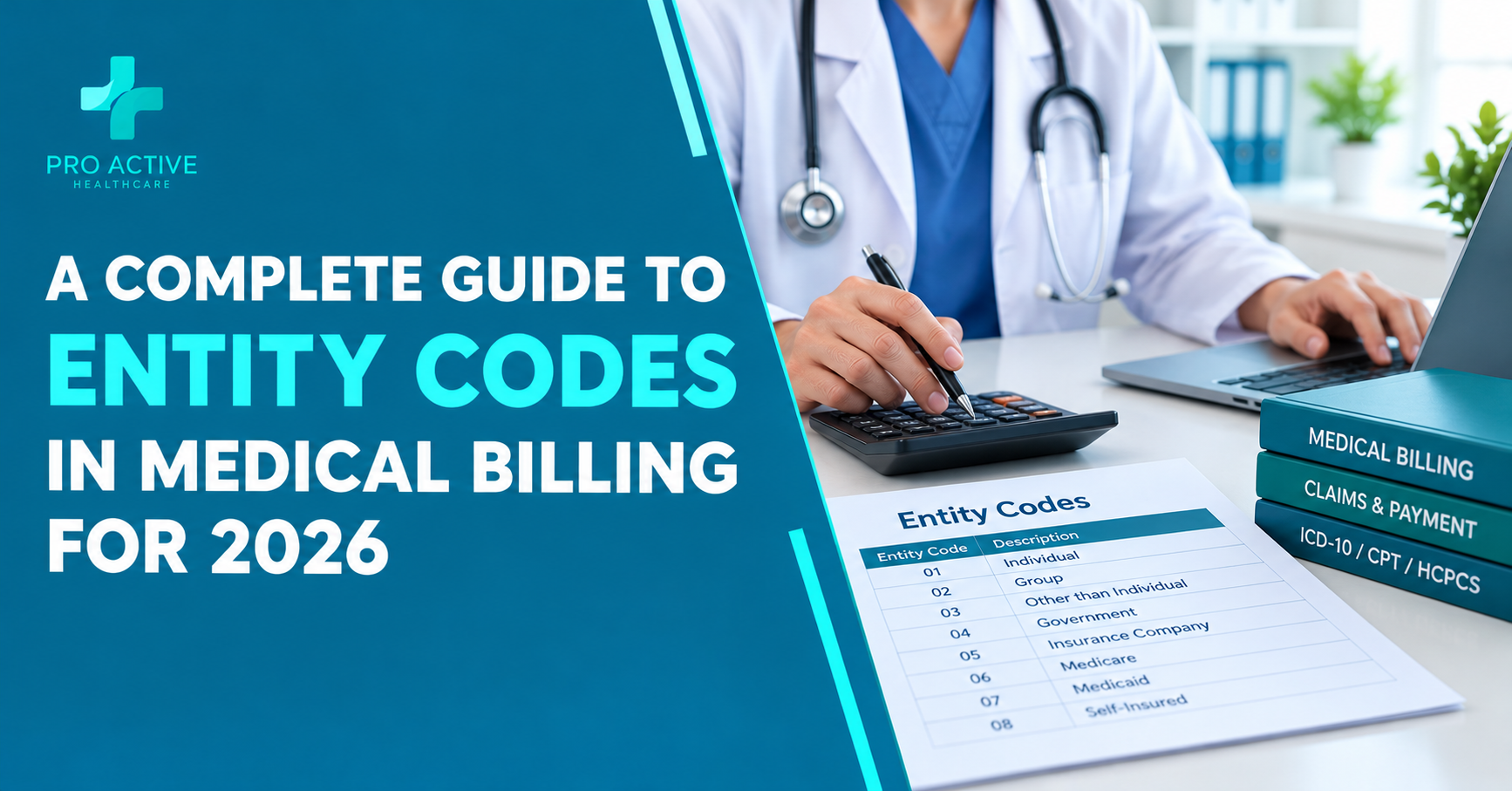
Entity codes in medical billing identify the parties involved in an electronic healthcare transaction, such as the billing provider, payer, patient, or rendering provider. These standardized X12 Entity Identifier Codes help billing teams understand whose name, address, or identifier appears in a claim or remittance record. They do not explain why a claim was denied or a payment was adjusted.
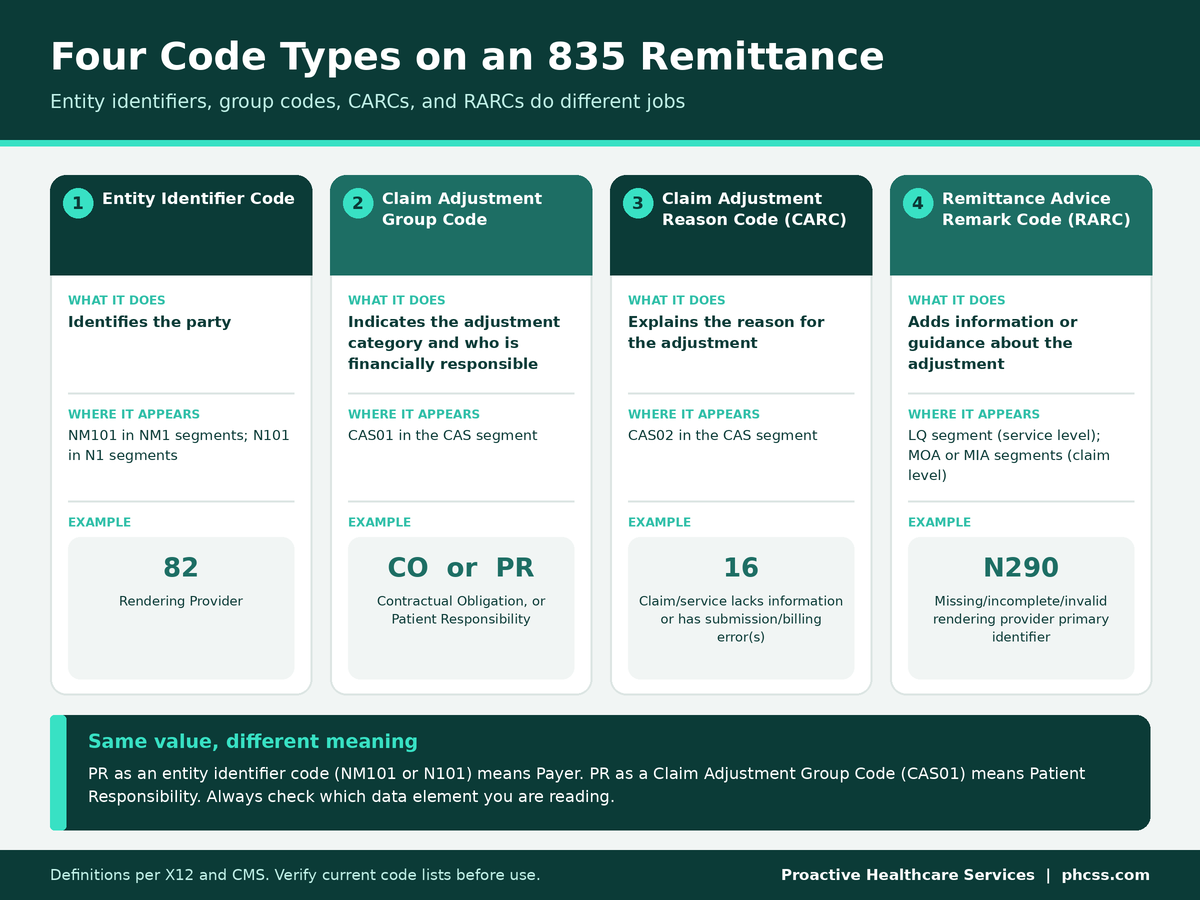
Understanding the difference matters when reviewing electronic remittance advice (ERA), investigating claim errors, and managing outstanding payments. Entity identifiers, Claim Adjustment Group Codes, Claim Adjustment Reason Codes (CARCs), and Remittance Advice Remark Codes (RARCs) serve different purposes. Confusing them can lead to incorrect follow-up, unnecessary claim corrections, and avoidable administrative work.
This guide explains how entity codes work in 837 healthcare claims and 835 remittance transactions, how they differ from adjustment codes, and how billing teams can use them to investigate common problems. Proactive Healthcare Services supports US healthcare organizations with billing and revenue cycle operations, where accurate claim information and consistent review processes play an important role.
What Are Entity Codes in Medical Billing?
An entity code, formally known as an Entity Identifier Code, is a standardized value used to identify an individual, organization, or other party in an electronic transaction. In healthcare electronic data interchange (EDI), these codes help identify the party associated with a particular name or identification number.
For example, an 837 professional claim may use entity code 85 to identify the billing provider and 82 to identify the rendering provider. An 835 remittance may use Patient Responsibility Codes to identify the payer in the appropriate entity identifier field.
Entity codes commonly appear in X12 segments such as NM1, which carries individual or organizational name information, and N1, which identifies a party in applicable transaction contexts. The exact meaning and permitted use depend on the transaction, segment, and implementation guide.
Three distinctions help prevent common mistakes:
-
- Entity Identifier Codes identify a party. They answer who is being identified.
- Claim Adjustment Group Codes categorize financial responsibility. They help explain how an adjustment is assigned.
- CARCs and RARCs explain adjustment information. They describe the reason for an adjustment and provide additional details.
Entity codes are also different from National Provider Identifiers (NPIs) and provider taxonomy codes. An NPI is a unique 10-digit identifier assigned to an eligible healthcare provider. A taxonomy code describes a provider’s classification or specialty. These identifiers may appear in the same electronic transaction as entity codes, but they serve different purposes.
How Do Entity Codes Work in Medical Billing?
Healthcare claims move through electronic transactions that identify providers, patients, payers, and other parties. Entity codes help systems interpret these details consistently.
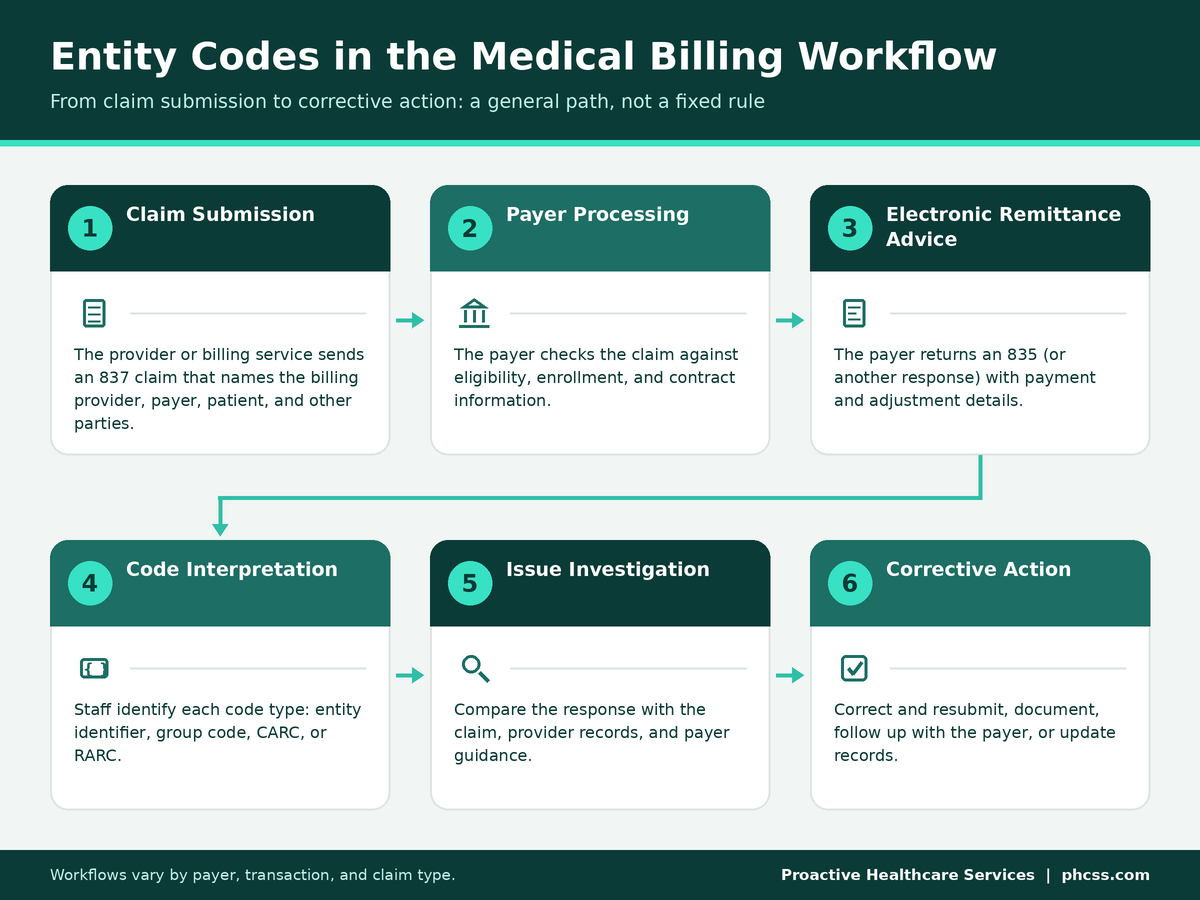
1. The provider submits an 837 claim
The healthcare organization or its medical billing services partner submits an electronic claim to a payer, often through a clearinghouse. The 837 transaction identifies relevant parties, including the billing provider, subscriber, patient when applicable, and rendering provider.
The appropriate entity identifier helps the receiving system determine which party the associated name and identification information represent.
2. The payer processes the claim
The payer evaluates the claim against applicable coverage, billing, enrollment, and payment requirements. Incorrect or inconsistent provider and patient information may require further investigation.
An entity code does not determine whether the claim is payable. It helps identify the party associated with the information being processed.
3. The payer returns a response
Depending on the stage of processing, the provider may receive an acknowledgment, a claim status response, or an 835 Health Care Claim Payment/Advice transaction.
The 835 explains payment and adjustment information. CMS explains that Medicare remittance advice uses standardized adjustment codes and that the applicable group code, CARC, and RARC provide different parts of the explanation. Provider-level adjustments may use separate Provider Level Balance (PLB) reason codes. Read CMS guidance on health care payment and remittance advice.
4. The billing team investigates the result
The billing team reviews the remittance, identifies the relevant code and segment, and compares the information with the submitted claim and payer requirements.
This process helps staff determine whether the next step involves correcting claim data, updating provider information, contacting the payer, or recording an adjustment accurately.
An illustrative example: Rendering provider information
Suppose a group practice submits a professional claim with the group as the billing provider and an individual physician as the rendering provider.
The payer’s remittance includes CARC 16 with RARC N290, which identifies a missing, incomplete, or invalid rendering provider primary identifier. Before resubmitting, the billing team reviews the adjustment information and locates the rendering provider party in the 835, represented by an NM1 segment using entity code 82 in Loop 2100 when applicable.
The team compares the provider information with the submitted claim and checks whether the rendering provider’s NPI is correctly reported and associated with the group where required.
Possible causes include a data-entry error, an incorrect or missing NPI, or a provider enrollment issue. Noridian Medicare guidance documents this CARC and RARC combination for missing or incorrect required NPI information. Its instructions, including the handling of an unprocessable claim, are Medicare contractor guidance and should not be assumed to apply identically to every commercial payer.
The example is illustrative, not a claim that CARC 16 and N290 always appear together.
Common Entity Codes and Their Meanings
X12 defines Entity Identifier Codes in data element 98. The 837 and 835 implementation guides specify how the codes are used in particular transaction loops and segments. The following table covers selected values relevant to medical billing.
|
Code |
Meaning in the relevant context |
Example location |
Practical use |
|
85 |
Billing Provider |
837, Loop 2010AA, NM101 |
Identify the provider or organization billing for the services. |
|
82 |
Rendering Provider in the 837; Service Provider Name in the 835 |
837 Professional, Loop 2310B; 835, Loop 2100, NM1 |
Identify the professional who performed the service, where applicable. |
|
QC |
Patient |
837, Loop 2010CA when applicable; 835, Loop 2100, NM1 |
Identify the patient associated with the claim. |
|
PR |
Payer in the entity identifier field |
837, Loop 2010BB, NM101; 835, Loop 1000A, N101 |
Identify the payer in the appropriate transaction context. |
|
PE |
Payee |
835, Loop 1000B, N101 |
Identify the party receiving the payment. |
Important: This is a selected reference table, not a complete list of X12 Entity Identifier Codes. Always verify code definitions and permitted usage against the applicable implementation guide and payer companion guide.
In the 835, the NM1 segments in Loop 2100 share the same logical position, so their order is not meaningful. Read the entity code and the associated segment information instead of assuming that a party can be identified by its position in the file. X12 addresses the rendering provider’s use in the 835 in its RFI 1270 interpretation.
Entity Codes vs. CARCs, RARCs, and Group Codes
These code categories often appear in the same remittance transaction, but they are not interchangeable.
|
Code category |
Purpose |
Example |
|
Entity Identifier Code |
Identifies a party in a transaction |
82, Rendering Provider |
|
Claim Adjustment Group Code |
Categorizes responsibility for a financial adjustment |
CO, Contractual Obligation |
|
Claim Adjustment Reason Code (CARC) |
Explains the general reason for an adjustment |
16, claim or service lacks required information or has a submission or billing error |
|
Remittance Advice Remark Code (RARC) |
Provides additional explanation or instructions |
N290, missing, incomplete, or invalid rendering provider primary identifier |
CMS explains that group codes assign financial responsibility for unpaid claim balances, CARCs provide the overall adjustment explanation, and RARCs can add more specific information. Provider-level adjustments are explained separately through PLB reason codes. Review the CMS remittance advice guidance.
Watch for identical code values
The same two-character value can mean different things depending on where it appears.
For example, PR in the entity identifier field means Payer, while PR in the Claim Adjustment Group Code field means Patient Responsibility. The surrounding segment and data element determine the meaning.
This distinction is particularly important when reviewing an 835 file or troubleshooting an automated payment posting system. Staff should confirm the code’s location and category before acting on it.
Common Entity Code Interpretation Mistakes
Treating all codes as the same type
Entity identifiers do not explain why an adjustment occurred. CARCs, RARCs, and group codes have separate roles. Confusing these categories can send staff toward the wrong correction or payer inquiry.
Reviewing a code without the claim context
A code may be easy to recognize but difficult to interpret without the associated claim, service line, provider information, and transaction details. Review the complete relevant record before deciding what needs correction.
Resubmitting before identifying the cause
Resubmitting a claim without confirming the issue can lead to another rejection, duplicate-submission concerns, or unnecessary work. Identify the exact problem first, then follow the payer’s instructions.
Ignoring payer-specific guidance
X12 standards define transaction structures, but payer companion guides and provider manuals explain implementation requirements. A billing team should consult the applicable guidance rather than assume every payer handles a situation identically.
Failing to document recurring errors
If the same provider identifier issue occurs repeatedly, correcting individual claims may not resolve the underlying process problem. Track the cause, action taken, and payer involved so the team can identify patterns.
Overlooking provider enrollment information
A rendering provider’s information may be correct on the claim but inconsistent with the payer’s enrollment records. Provider enrollment and provider-to-group relationships can affect claim processing. Accurate credentialing services support these records, although credentialing itself does not interpret remittance codes.
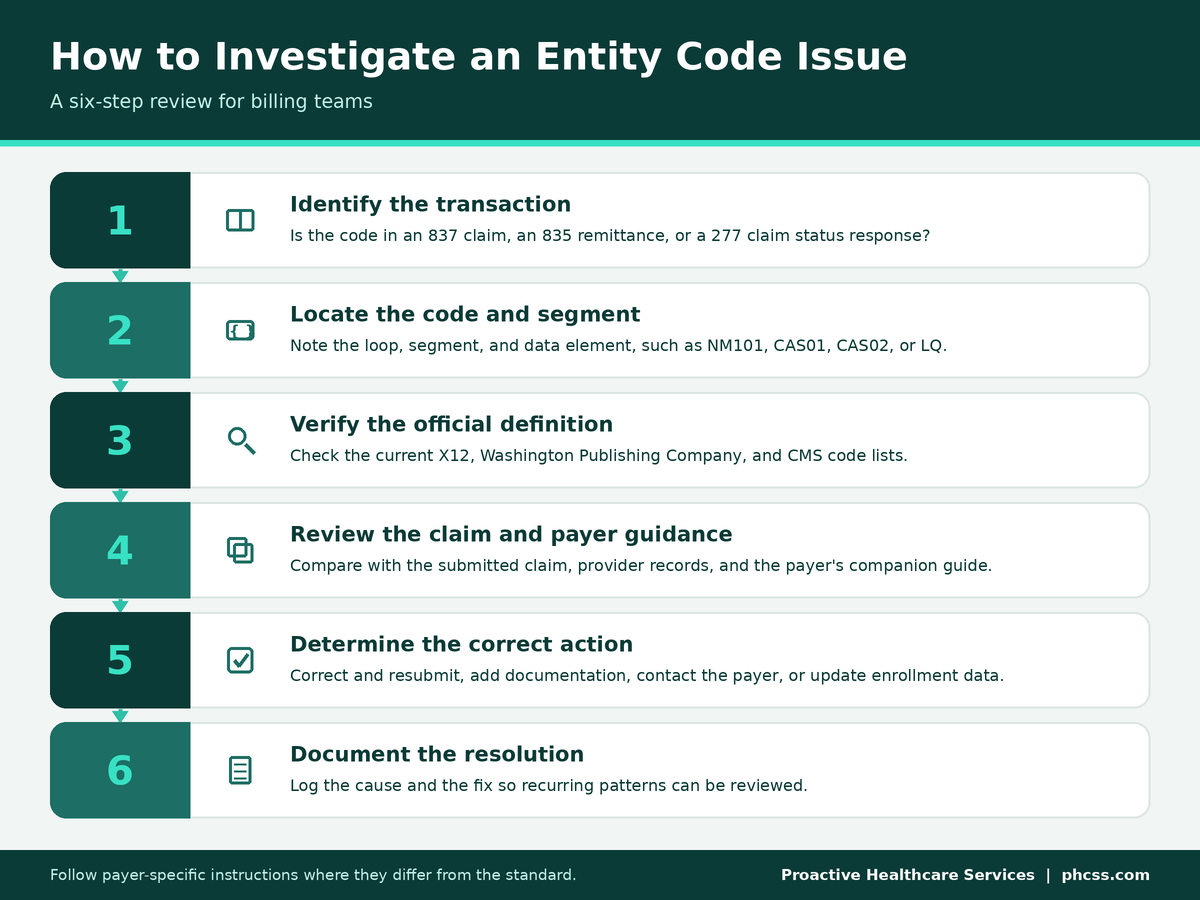
How to Resolve Entity Code Issues in Medical Billing
A consistent review process helps billing teams investigate unfamiliar codes and avoid unnecessary corrections.
Step 1: Review the remittance or claim response.
Open the relevant 835 electronic remittance advice or claim response. Identify the claim, patient, affected service lines, adjustment information, and any associated remark codes.
Step 2: Identify the transaction and code type.
Determine whether the code is an entity identifier, a Claim Adjustment Group Code, a CARC, or a RARC. Locate the relevant segment, loop, and data element.
Step 3: Verify the official definition.
Consult the applicable X12 implementation guide and code list. Review CMS documentation when relevant and check the payer’s companion guide or provider manual.
Step 4: Compare the claim information.
Review the original submission alongside the remittance. Check the relevant patient, provider, identifier, and service information. For provider-related problems, verify the NPI and payer enrollment details where applicable.
Step 5: Determine the appropriate action.
Depending on the finding, the team may need to correct claim information, submit supporting documentation, contact the payer, update provider enrollment records, or post the adjustment correctly. Follow the applicable payer instructions.
Step 6: Record the resolution.
Document the code type, issue, root cause, payer, and action taken. Review recurring problems to determine whether staff training, claim validation, or workflow improvements are needed.
A simple tracking sheet can help teams identify repeated errors without introducing an unnecessarily complex process.
How Entity Codes Affect Revenue Cycle Management
Revenue Cycle Management covers the administrative and financial processes involved in managing healthcare revenue, from registration and claim submission through payment posting and accounts receivable follow-up.
Correct interpretation of entity codes supports several parts of this process.
Payment posting: Staff need to identify the payee and distinguish party information from financial adjustment information. This helps keep remittance data aligned with the correct account.
Accounts receivable follow-up: Accurate interpretation helps staff determine which party or record needs investigation before contacting the payer or taking further action.
Denial management: Entity codes provide context about the parties involved, while CARCs, RARCs, and group codes help explain the adjustment. Reading them together supports a more focused investigation.
Reporting and audits: Consistent code interpretation improves the quality of billing reviews and helps teams identify recurring issues rather than treating every affected claim as an isolated problem.
Professional medical billing services can support claim submission, payment posting, follow-up, and billing workflow management. Medical billing audit services can review selected claims, remittances, and internal processes to identify recurring documentation, coding, or data-handling issues.
Credentialing services play a related role by helping maintain provider enrollment information and payer participation records. When provider information is accurate and up to date, billing teams have a stronger foundation for resolving provider-related claim issues.
Proactive Healthcare Services provides healthcare-related billing and revenue cycle support for organizations seeking to improve their processes. The appropriate service depends on the organization’s workflows, existing systems, and specific operational needs.
Frequently Asked Questions
Q1-What are entity codes in medical billing?
Entity codes are standardized X12 identifiers that identify parties in electronic healthcare transactions. They may identify a billing provider, rendering provider, payer, payee, or patient, depending on the transaction context. They do not independently explain why a claim was denied or adjusted.
Q2-Are entity codes the same as claim adjustment reason codes?
No. Entity Identifier Codes identify parties, while Claim Adjustment Reason Codes explain why a claim or service payment was adjusted. Claim Adjustment Group Codes categorize financial responsibility, and Remittance Advice Remark Codes provide additional explanations or instructions.
Q3-Where can medical billers verify an entity code?
Medical billers should consult the applicable X12 code list and implementation guide for the transaction being reviewed. CMS provides Medicare remittance advice guidance, while payer companion guides describe payer-specific requirements. Always confirm the relevant segment, data element, and transaction version.
Q4-Can an entity code cause a claim denial?
An entity identifier does not independently determine whether a claim is denied. However, incorrect or inconsistent party information associated with the identifier may contribute to a rejection, adjustment, or processing problem. The actual outcome depends on the error, transaction requirements, and payer rules.
Q5-How can billing teams correct entity code-related errors?
First identify the transaction and code category. Then verify the official definition, review the relevant claim and provider information, and consult payer guidance. Depending on the findings, the next step may involve correcting the claim, updating enrollment information, contacting the payer, or documenting the resolution.
Q6-How do entity codes support Revenue Cycle Management?
Entity codes help billing teams identify the parties associated with a claim or remittance. When staff interpret them alongside adjustment codes and claim details, they can investigate issues more efficiently, improve payment posting accuracy, and direct follow-up to the appropriate problem.
Conclusion
Entity codes in medical billing help identify the parties involved in electronic healthcare transactions. Although these identifiers may appear alongside payment adjustments and claim remarks, they serve a different purpose from Claim Adjustment Group Codes, CARCs, and RARCs.
A reliable billing workflow starts by identifying the transaction and code type, checking authoritative definitions, reviewing the related claim information, and following the applicable payer instructions. Consistent documentation also helps teams identify recurring issues and improve billing processes.
If your organization needs support with medical billing workflows, claim review, or Revenue Cycle Management, Proactive Healthcare Services can help you explore relevant support options.