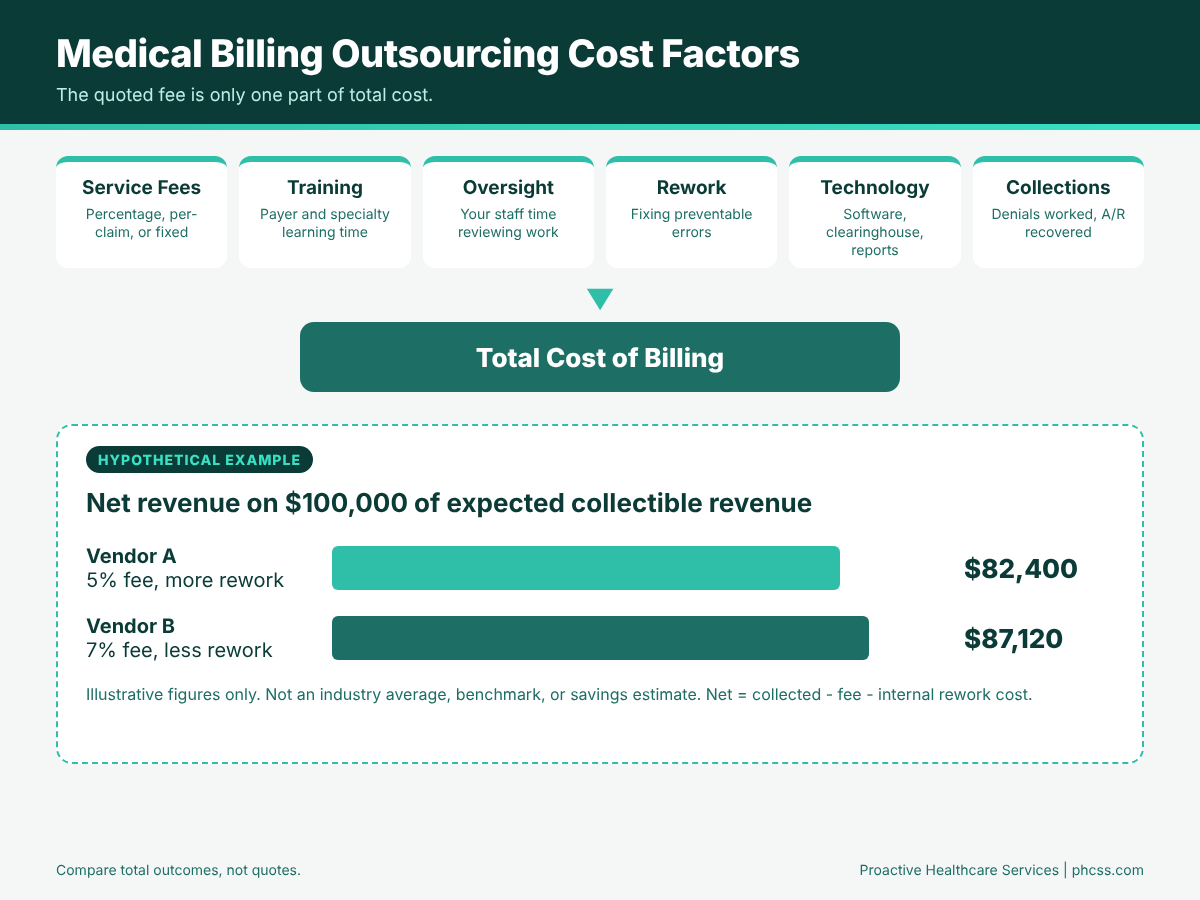
A Simple Hypothetical Example
These numbers are illustrative only. They are not market rates or benchmarks, and they are not tied to any location. A practice expects about $100,000 in collectible revenue in a month and compares two vendors.
| Vendor A (lower fee) | Vendor B (higher fee) | |
| Fee | 5% of collections | 7% of collections |
| Amount collected | $88,000 | $94,000 |
| Vendor fee | $4,400 | $6,580 |
| Internal rework cost | $1,200 | $300 |
| Net revenue | $82,400 | $87,120 |
Here, the lower fee results in less net revenue because the vendor handles denials less thoroughly, forcing the practice to spend more time and resources on rework. It could happen the other way around. Compare total outcomes, not quotes.
HIPAA Compliance and Data Security in Medical Billing Outsourcing
HIPAA, the Health Insurance Portability and Accountability Act, assigns obligations based on the parties’ roles and the data involved, not simply on where a vendor is located.
Business associates. HHS explains that a business associate is generally a person or organization, other than a covered entity’s workforce member, that performs functions or services for the covered entity involving PHI. A billing company handling PHI on a provider’s behalf typically fits.
Business associate agreements (BAAs). A covered entity may disclose PHI to a business associate only after obtaining satisfactory assurances in a written contract or arrangement. The agreement must describe permitted uses and disclosures, and a business associate needs its own BAA with any subcontractor before sharing PHI.
Direct responsibility and safeguards. Business associates can be held directly liable for certain obligations, including security safeguards and breach notification. HHS: Direct Liability The Security Rule requires appropriate administrative, physical, and technical safeguards for electronic PHI.
What about offshore?
HIPAA does not automatically prohibit it. In its cloud computing guidance, HHS says the HIPAA Rules contain no overseas-specific requirements, but that outsourcing services for ePHI overseas “may increase the risks and vulnerabilities” that organizations should consider in their risk analysis (HHS: Cloud Computing). That guidance addresses cloud service providers, so treat it as a signal about risk analysis, not a rule written for billing companies.
HIPAA is not the only layer. State privacy laws, payer contracts, and organizational policies may impose additional requirements, including restrictions on where teams can access data. Consult legal counsel to confirm these requirements separately.
A signed BAA does not prove that a vendor follows sound security practices, and any claim of HIPAA-compliant medical billing requires supporting documentation. Ask the vendor to provide written security policies, a recent risk analysis, role-based access controls, activity logs, workforce training records, encryption practices, and incident response procedures. Also request a list of subcontractors who can access PHI and clear details about where the vendor accesses and stores PHI. Strong healthcare data security depends on controls you can verify, not simply on a compliance label.
Which Model Offers Better Medical Billing Accuracy?
Neither has a built-in edge. Medical billing accuracy follows process, not geography. These factors move it:
- Training and specialty knowledge. Billers who know cardiology or behavioral health catch issues generalists miss.
- Claim scrubbing. Automated and manual checks catch missing data and invalid codes before submission.
- Coding and documentation workflows. Clear steps for matching codes to the clinical record reduce denials.
- Quality assurance. Regular reviews and periodic medical billing audit services show where errors start.
- Denial tracking and root-cause analysis. Fixing the source of repeat denials beats resubmitting the same claim.
- Standard procedures and escalation. Written processes keep results consistent when staff change.
Agree in writing on a few indicators: clean claim rate (claims accepted on first submission), denial rate, days in A/R, payment posting timeliness, and net collection rate (the share of collectible revenue actually collected). Definitions vary between vendors and software, so confirm them first, and interpret results in context of specialty and payer mix. No vendor can responsibly guarantee a specific improvement.
Advantages and Disadvantages of Onshore Medical Billing
Potential advantages: time-zone alignment, daily exposure to US payer environments, easier direct collaboration, and possibly simpler alignment with data-location policies.
Potential disadvantages: labor costs can be higher, smaller teams may have less surge capacity, and vendor expertise varies. Some onshore companies specialize deeply while others serve every specialty at a shallow level.
Onshore companies are not all alike. Some use fully domestic teams, some use hybrid models, and reporting depth varies. Evaluate the individual company.
Advantages and Disadvantages of Offshore Medical Billing
Potential advantages: lower labor costs may create pricing flexibility, larger teams can scale with claim volume, and some vendors structure shifts to extend coverage. Savings are never guaranteed once oversight and rework are included.
Potential disadvantages: time-zone gaps can slow communication, training on US payer rules must be ongoing and documented, vendor oversight takes provider time, and data access from outside the US requires careful risk analysis and contract clarity.
Offshore operations are not inherently lower quality. A well-run offshore team with strong audits and clear escalation can perform very well. Management discipline matters more than the map.
Onshore vs. Offshore Medical Billing: Which Is Right for Your Practice?
The right choice depends on practice size, specialty, claim volume, internal staffing, complexity, communication needs, budget, and your capacity to oversee a vendor. These scenarios are examples, not rigid rules.
- A small practice that needs close coordination with existing staff. Same-day answers may matter more than the lowest fee. Look for strong overlap hours and a named point of contact, onshore or offshore.
- A growing group practice seeking added capacity. Ask how quickly a vendor can add trained staff without lowering quality, and how reporting holds up as volume grows.
- A multi-specialty organization with complex denial management. Specialty depth and root-cause analysis matter most. Ask vendors to show how they handle appeals and payer-specific rules.
- An organization outsourcing selected tasks only. Some providers keep front-end work in house and outsource payment posting or A/R follow-up. Clear handoffs and shared reporting are essential.
How to Choose a Reliable Medical Billing Company
Evaluate actual controls and results rather than marketing claims or geographic labels.
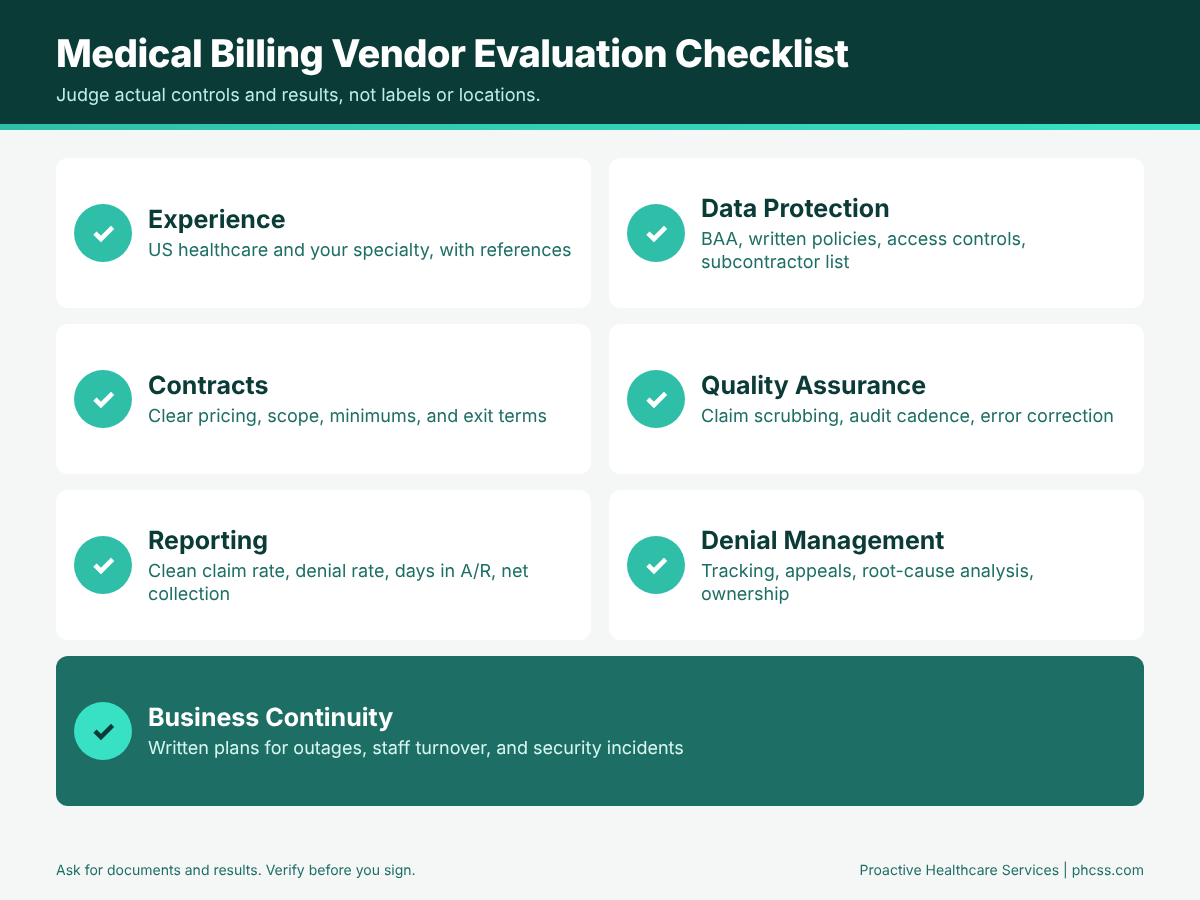
- Experience. US healthcare and specialty experience, with verifiable references.
- Pricing and scope. Written fees, minimums, setup costs, and extra charges.
- Security and agreements. Security policies, BAA terms, and workforce training proof.
- Data access. Who can access PHI, from where, and which subcontractors are involved.
- Quality assurance. How often claims and coding are audited and errors corrected.
- Reporting. Agreed indicators such as clean claim rate and days in A/R.
- Denial management. How denials are tracked, appealed, and analyzed.
- Continuity and incident response. Written plans for outages, turnover, and security incidents.
- Transition and exit. Onboarding steps and how data and accounts return to you.
- Unresolved accounts. Who follows up on old claims, and for how long.
How Can PHCSS Support Your Medical Billing and RCM Strategy?
At Proactive Healthcare Services (PHCSS), we support healthcare providers with medical billing services and revenue cycle management services built around the full billing workflow, from eligibility verification, coding, and charge entry to claim submission, payment posting, A/R follow-up, denial management, and reporting. Our reporting tracks submitted claims, approved payments, denied claims, and reimbursement patterns, so practices can see how their revenue cycle is performing.
We also offer medical billing audit services, specialty-focused billing, and HIPAA security risk analysis for organizations that want a closer look at accuracy and compliance. If you are weighing different billing models, PHCSS can be a partner for discussing your workflow, reporting expectations, and compliance requirements, and the checklist above works well in that conversation, including questions about team structure and data access.
Looking for Support? Get expert assistance with Medical Billing, MIPS Reporting & RCM. Talk to Our Experts: +1 888-586-8881 | Visit PHCS
Frequently Asked Questions
1. What is the difference between onshore and offshore medical billing?
Onshore billing is done by teams inside the United States, and offshore billing by teams in other countries. Differences usually involve cost structure, time-zone overlap, scalability, and oversight, but quality depends on each vendor’s processes.
2. Is offshore medical billing allowed under HIPAA?
HIPAA does not automatically prohibit it. HHS says the HIPAA Rules have no overseas-specific requirements in its cloud guidance, but advises that overseas outsourcing may raise risk that belongs in your risk analysis. State laws, payer contracts, and your own policies may add limits.
3. Is onshore medical billing more expensive?
The quoted price is often higher, but total cost is what matters. Rework, denials, oversight, and collections can outweigh a lower fee in either direction.
4. Can offshore medical billing teams work with US insurance companies?
Yes, many do, usually by working in billing systems and following payer rules. Ask how the team is trained on current payer policies and how errors are caught before submission.
5. Which medical billing model offers better accuracy?
Neither has a built-in advantage. Accuracy depends on training, claim scrubbing, audits, and denial analysis, so compare vendors using agreed metrics.
6. How can healthcare providers protect patient information when outsourcing billing?
Sign a business associate agreement, verify documented safeguards, limit access by role, and review incident response plans. Confirm who can access PHI, from where, and which subcontractors are involved.
7. Can a practice outsource only selected medical billing tasks?
Yes. Many organizations outsource payment posting, denial follow-up, or A/R management while keeping other work in house. Define handoffs, reporting, and responsibility for unresolved claims in writing.
8. What should a healthcare provider ask before hiring a medical billing company?
Ask about specialty experience, pricing, security documentation, data access, audits, reporting, denial handling, continuity planning, references, and exit terms. The checklist above covers each point.
Conclusion
Choosing between onshore and offshore medical billing means weighing total cost, service quality, communication, security, compliance, oversight, and measurable results, and location alone does not guarantee better performance. A well-managed team with strong controls and clear reporting can serve a practice well in either model, so providers should evaluate vendors through documented controls, transparent reporting, relevant expertise, and clearly defined responsibilities, then review results regularly as the practice grows.
Ready to review your billing workflow? Visit Proactive Healthcare Services to explore medical billing and revenue cycle support for your organization, or call +1 888-586-8881 to talk to our experts.