| Written for US medical practice owners, administrators, and billing managers. This guide offers general information and is not legal, coding, or compliance advice. |
RCM Services cover every financial step between a patient booking an appointment and your practice receiving full payment for that visit. That includes insurance eligibility checks, prior authorization, medical coding, claim submission, payment posting, denial management, patient billing, and reporting. A strong partner runs these steps as one connected process, so errors get fixed at the source instead of being reworked after a payer denies the claim.
This guide explains what is included in RCM services, what usually costs extra, how pricing works, what your first 90 days should look like, which numbers to hold a vendor to, and which federal rules apply. Use it to compare vendors with confidence or to check what your current biller actually delivers.
What Are RCM Services in Healthcare?
Revenue cycle management (RCM) is the process that follows a patient account from scheduling and registration through final payment. RCM services are the tasks a billing company or an internal team performs to run that process. They begin before the patient arrives and end only when the balance is paid, adjusted under policy, or transferred to collections.
People often use RCM and billing as if they mean the same thing, but Medical Billing is one part of the cycle. Billing covers creating claims and following up on them. RCM also covers patient access, coding review, payer enrollment, contract monitoring, analytics, and compliance. Billing is one lane, and Revenue cycle management is the whole road.
RCM services also differ from RCM software. A practice management system, EHR, or clearinghouse is a tool. A service is a team that uses those tools, works your accounts every day, and answers for the results. Many vendors sell both, which is why it helps to ask who actually does the work.
Payers shape every step. Medicare, Medicaid, Medicare Advantage plans, Medicaid MCO plans, and commercial insurers each publish their own rules for claim format, timely filing, authorization, claims processing time and appeals; your RCM team has to track all of them.
What Is Included in RCM Services?
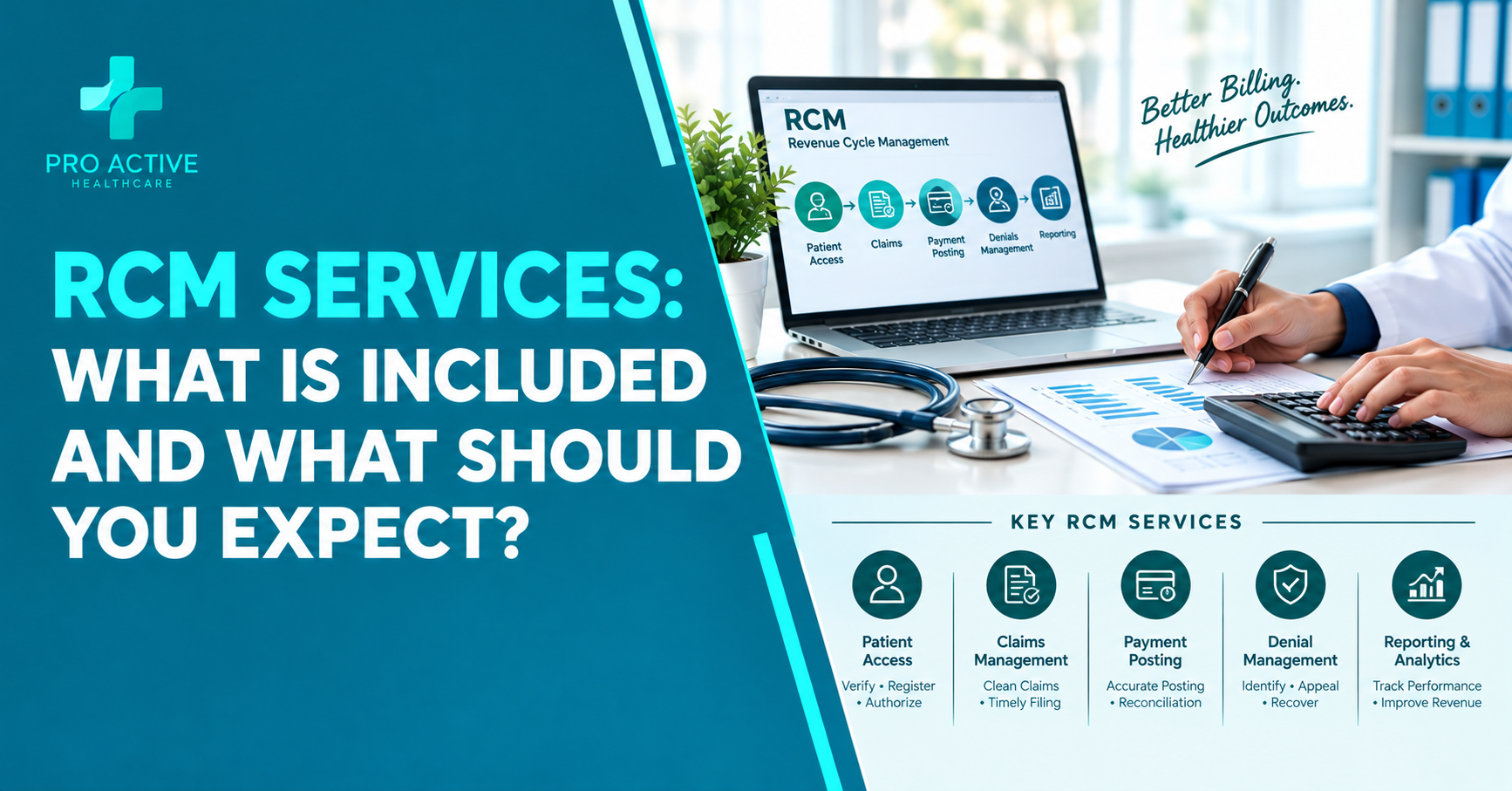
A full-service Revenue cycle management arrangement usually includes the ten functions below, listed roughly in the order they occur. Smaller arrangements may cover only some of them, so confirm the scope in writing.
Eligibility and Benefits Verification
Before the visit, the team confirms active coverage, the payer on file, copay, deductible, coinsurance, referral requirements, and whether the planned service needs an authorization. A wrong subscriber ID or a lapsed policy is one of the most common reasons a clean-looking claim is later denied, so this step prevents problems instead of fixing them.
Prior Authorization
Prior authorization is approval from the payer before certain procedures, imaging, specialty drugs, or referrals. The rules are changing. Under the CMS Interoperability and Prior Authorization final rule (CMS-0057-F), certain government-regulated payers, including Medicare Advantage organizations and state Medicaid programs, must meet shorter decision timeframes beginning in 2026: 72 hours for urgent requests and seven calendar days for standard ones. Ask your vendor how they track authorizations against these timelines.
Charge Capture and Medical Coding
Charge capture turns documented care into billable items. Coding then converts that documentation into CPT codes (maintained by the American Medical Association), ICD-10-CM diagnosis codes (maintained by the CDC’s National Center for Health Statistics), HCPCS Level II codes (maintained by CMS), and the modifiers that explain special circumstances. Credentialed coders, such as those holding AAPC or AHIMA certifications, follow official coding guidelines and the CMS National Correct Coding Initiative (NCCI) edits. Coding should reflect what the provider documented, never what would pay more. When documentation is unclear, a good coder sends a query to the provider instead of guessing.
Claim Scrubbing and Submission
Professional claims are billed on the CMS-1500 form and institutional claims on the UB-04, and both travel electronically in HIPAA-standard 837 transactions through a clearinghouse. Claim scrubbing software checks each claim for missing modifiers, mismatched diagnosis and procedure codes, invalid payer IDs, and payer-specific rules before it goes out. Speed matters because deadlines are firm. Medicare generally requires claims within 12 months of the date of service, and many commercial contracts allow far less, often 90 to 180 days.
Payment Posting and Reconciliation
When a payer pays, it sends an electronic remittance advice (the 835 transaction) or a paper explanation of benefits. The team posts the payment, applies contractual adjustments, and reads the claim adjustment reason codes (CARCs) and remittance advice remark codes (RARCs) that explain every reduction. Strong teams also compare each payment with the contracted fee schedule, because underpayments rarely announce themselves.
Denial Management and Appeals
Denial management goes beyond resubmitting. The team sorts denials by cause, such as eligibility, coding, medical necessity, authorization, or timely filing, fixes what can be fixed, and appeals what cannot. Medicare, for example, allows 120 days from receipt of the initial determination to request a redetermination, the first level of appeal. Industry estimates often put the cost to rework one denied claim near $25, and many denied claims are never resubmitted at all, so unworked denials quietly become write-offs.
Accounts Receivable Follow-Up
Unpaid claims are grouped by age, usually 0 to 30, 31 to 60, 61 to 90, 91 to 120, and over 120 days, and worked in priority order through payer portals and phone calls. Every touch should be documented with a date, a name, and a next step. Claims sitting past 120 days are the clearest warning sign of a weak follow-up process.
Patient Billing and Collections
After insurance pays, patients owe copays, deductibles, and coinsurance. Under Medicare Part B, for instance, patients generally owe 20 percent coinsurance for covered services. Revenue cycle management teams send clear statements, set up payment plans, support online payment, and follow the practice’s collection policy. For self-pay and uninsured patients, the No Surprises Act requires good faith estimates of expected charges, and your team should know how to produce them.
Credentialing and Payer Enrollment
A provider cannot bill a payer until enrolled with it. That work involves the National Plan and Provider Enumeration System (NPPES) for the NPI, the Provider Enrollment, Chain and Ownership System (PECOS) for Medicare, CAQH ProView for many commercial payers, and individual payer contracts. Commercial credentialing commonly takes months, and Medicare revalidation is generally required every five years. Many vendors price this work separately.
Reporting, Analytics, and Compliance Support
Expect a monthly report at minimum, covering claims submitted, collections, A/R aging, and key performance indicators. Compliance support includes a signed business associate agreement, HIPAA-compliant data handling, and cooperation with audits.
What Is Typically Included and What Costs Extra?
Scope disputes are one of the main sources of friction between practices and billing companies. The table shows how services are commonly packaged. Quotes vary, so treat it as a checklist for your own conversation.
| Service area | Usually in the base package | Often quoted as an add-on |
| Eligibility verification | Checks before scheduled visits | Same-day checks, complex benefit investigations |
| Prior authorization | Routine requests and tracking | High-volume specialties, drug authorizations, peer-to-peer support |
| Coding | Charge review and standard coding | Full coding from clinical notes, documentation improvement programs |
| Claim submission | Scrubbing and clearinghouse submission | Paper claims, special payer portals |
| Denial management | Corrections, resubmission, standard appeals | Complex or external appeals, No Surprises Act dispute resolution |
| A/R follow-up | Current claims | Cleanup of accounts older than 120 days |
| Patient billing | Statements and basic follow-up | Patient call center, collection agency placement |
| Credentialing | Often not included | New provider enrollment, revalidation, CAQH maintenance |
| Reporting | Standard monthly reports | Custom dashboards, board-level analytics |
Ask each vendor to mark every line as included, extra, or not offered. Do the same for onboarding, EHR configuration, and data migration.
Why Does RCM Matter for a Medical Practice?
The Importance of RCM shows up in cash flow before it shows up anywhere else. A practice can have a full schedule and still struggle to make payroll if claims are denied, delayed, or underpaid. Revenue leaks in four places: services never billed, claims billed incorrectly, claims denied and never appealed, and payments received at the wrong amount.
Margins make those leaks costly. Staff wages, malpractice insurance, rent, and technology costs rise on schedule, while payer reimbursement often does not. When a practice collects a few percent less than it should, the loss lands directly on the bottom line. Strong Revenue cycle management also protects the patient experience, because clear estimates, accurate statements, and fewer billing errors mean fewer disputes and fewer frustrated phone calls.
How Much Do RCM Services Cost?
Pricing depends on specialty, claim volume, payer mix, and scope. Four models are common.
| Pricing model | How it works | Common market range | What to watch |
| Percentage of collections | Fee equals a share of payments collected | About 4 to 8 percent of net collections | Whether fees apply to gross or net, to reworked claims, and to payer rate increases |
| Per claim | Flat fee per claim or encounter | About $4 to $12 per claim | Volume can be rewarded over quality, and resubmissions may be billed |
| Flat monthly or dedicated staff | Fixed fee for a defined scope or team | Varies by scope | The fee is unrelated to results unless KPIs are written in |
| Hybrid | Base fee plus performance bonus | Varies | Bonus targets should be specific, such as net collection rate, denial rate, and days in A/R |
These ranges are general and shift with specialty and volume. A lower percentage is not automatically a better deal. A more useful measure is cost to collect, which the Healthcare Financial Management Association (HFMA) defines as total revenue cycle cost divided by total cash collected.
Percentage pricing also carries a compliance note. The HHS Office of Inspector General (OIG) has long observed that paying a billing company a percentage of collections can create an incentive to code more aggressively, which is why those arrangements call for safeguards such as coding audits. Whatever model you choose, define exactly what counts as collections, whether fees apply to patient payments, how old A/R is priced, what setup fees apply, and what happens to your data and payer accounts if you leave.
What Should You Expect When You Start With an RCM Partner?
A well-run onboarding has a visible shape. Expect the following sequence, and be cautious if a vendor promises results before it has seen your data.
Days 1 to 30: Discovery and Setup
The vendor signs a business associate agreement, receives access to your EHR, practice management system, clearinghouse, and payer portals, and reviews your fee schedules and workflows. It should run a baseline analysis of your denials, A/R aging, charge lag, and credentialing status. You should meet a named account manager and agree on how questions and escalations are handled.
Days 31 to 60: Go-Live and Cleanup
New claims move to the vendor’s workflow, and existing A/R is prioritized and worked. The first denial analysis should identify repeat causes, and front-desk or provider feedback loops begin, such as correcting registration errors or documentation gaps.
Days 61 to 90: Optimization
By now you should see a full month of reporting, payer-specific trends, and an underpayment review. Clean claim rates and aging usually improve first. Because payment cycles run weeks or months, the full effect on cash often takes 60 to 120 days to appear, so judge progress on leading indicators as well as deposits.
After 90 Days: Ongoing Review
Hold a monthly performance call and a quarterly business review. Revisit targets, payer issues, and any scope changes.
What Stays on Your Side
RCM does not remove your responsibilities. Providers still need to document completely and on time, enter charges promptly, answer coding queries, collect what the practice policy requires at check-in, and approve write-offs. Vendors can only bill what the record supports, and delays on your side show up as delays in payment.
Which KPIs Should Your RCM Partner Report?
A vendor should report numbers, not impressions. Targets vary by specialty and payer mix, but these benchmarks are widely used in the industry.
| KPI | What it measures | Common benchmark |
| Clean claim rate | Claims accepted on first submission without edits | 95 to 98 percent or higher |
| Denial rate | Share of claims denied by payers | Under 5 percent is a common target |
| Days in A/R | Average days to collect after billing | 35 to 45 days or less |
| A/R over 120 days | Share of A/R that is old | Under 15 percent |
| Net collection rate | Collected dollars as a share of collectible dollars after contractual adjustments | 95 percent or higher |
| Charge lag | Days from date of service to charge entry | under 24 hours, with the industry benchmark and standard practice being 1 to 3 days |
| Cost to collect | RCM cost divided by cash collected | Lower is better; track the trend |
Ask for these metrics by payer, by provider, and by denial reason, not only as practice-wide totals. A healthy overall average can hide one payer that denies half of your claims.
Should You Outsource RCM or Keep It In-House?
Both models can work. The right choice depends on volume, staff stability, and how much management time you can spare.
An in-house team gives you direct control and close contact with providers and the front desk. It also brings fixed salary and benefit costs, training, turnover risk, software licenses, and coverage gaps during vacations and leave. A single departure can pause follow-up on hundreds of claims.
The Benefits of Outsourcing RCM include access to certified coders and denial specialists, capacity that scales with volume, predictable costs, formal reporting, and backup coverage. The tradeoffs are less day-to-day visibility, reliance on the vendor’s accuracy, and the need for strong contract terms. Many practices choose a hybrid arrangement in which the front desk verifies coverage and collects copays in-house, while an outside team handles coding review, claims, denials, and A/R.
Outsourcing tends to make sense when denial rates are rising, A/R is aging, billing staff are leaving, you are adding providers or locations, or the practice owner is spending evenings on billing problems. To Invest in Revenue Cycle Management Services wisely, compare the fully loaded cost of your current process (salaries, benefits, software, clearinghouse fees, training, and the cost of turnover) with the vendor’s fees and the change in net collections you can reasonably expect. Ask for baseline numbers first so the comparison rests on your data, not on a sales presentation.
How Do Billing Audits Fit Into RCM?
Medical Billing Audits work as a checkpoint at two stages. Before you hire a vendor, an audit of a sample of recent claims shows your baseline denial rate, coding accuracy, charge capture gaps, write-off patterns, and underpayments. After you hire one, recurring audits show whether performance is improving and whether coding stays supported by documentation.
A useful audit compares each claim with the clinical note, checks modifiers and NCCI edits, confirms the payment matches the contracted rate, and looks for services that were documented but never billed. The OIG’s compliance guidance for physician practices recommends periodic internal review of billing and coding, and that advice applies whether you bill in-house or through a third party. Ask any vendor how often they audit, how large the sample is, and whether you receive the findings in writing.
Which Laws and Rules Apply to RCM Services?
Several federal frameworks shape RCM work. Naming them in your contract and your vendor conversations shows that you take compliance seriously.
HIPAA and Business Associate Agreements
The HHS Office for Civil Rights enforces the HIPAA Privacy and Security Rules. A billing company that handles protected health information is a business associate, so you need a signed business associate agreement before any data is shared.
False Claims Act and OIG Guidance
Claims submitted under your NPI remain your responsibility even when a vendor prepares them. The OIG’s General Compliance Program Guidance and its earlier guidance for individual and small group physician practices both address third-party billing arrangements.
CMS Rules and Manuals
The Medicare Claims Processing Manual sets claim formats, timely filing limits, and payment timelines. Under the Medicare payment floor, clean electronic claims are not paid before day 14.
The No Surprises Act
This law governs good faith estimates for self-pay patients and the independent dispute resolution process for certain out-of-network payment disputes.
State Law
Prompt pay statutes, balance billing limits, and record retention requirements vary by state, so confirm your own state’s rules with qualified counsel.
How Do RCM Needs Differ by Specialty?
The core cycle is the same, but the pressure points change. Primary care involves high volume, evaluation and management coding, preventive services, annual wellness exams, chronic care management, and quality reporting. Behavioral health brings time-based psychotherapy codes, session authorizations, telehealth rules, and strict privacy expectations. Surgical and orthopedic practices deal with global periods, modifiers, implant billing, and heavy prior authorization. Anesthesia relies on time-based units and specialty modifiers. Laboratories and radiology face high claim counts, medical necessity edits, and low dollars per claim. Home medical equipment and pharmacy providers manage supplier enrollment, documentation requirements, and recurring billing, which is why some platforms are built only for them.
Ask any vendor for references and sample reports from your own specialty, not just general experience.
How Does MIPS Affect Revenue Cycle Performance?
The Merit-based Incentive Payment System (MIPS), part of the CMS Quality Payment Program, adjusts Medicare Part B payments up or down by as much as 9 percent based on performance in quality, promoting interoperability, improvement activities, and cost. That makes it a revenue issue as well as a reporting task. Claims data feeds several quality measures, and complete documentation supports both accurate coding and accurate measure reporting. An unreported performance year can lead to a negative payment adjustment two years later. Ask whether your RCM partner supports MIPS reporting directly or coordinates with someone who does.
What Red Flags Should You Watch For When Choosing an RCM Partner?
Some warning signs deserve a pause. A promise of a specific collection increase before anyone has reviewed your data is not credible. Refusal to sign a business associate agreement is disqualifying. Be cautious if the vendor will not give you ownership of your data, payer portal logins in your name, and read access to the clearinghouse. Watch for long lock-in terms with heavy termination fees, unclear definitions of collections, no named account manager, and reports that show totals but no breakdown by payer or denial reason.
Ask about contingency plans too. The 2024 cyberattack on Change Healthcare, a major clearinghouse, stalled claims for many practices nationwide and showed the value of a backup submission route. Finally, be wary of any approach that treats coding as a way to raise revenue instead of documenting care accurately.
What Questions Should You Ask Before You Sign?
- Who will work my accounts, where are they located, and how is protected health information accessed and secured?
- Which services in this proposal are included, and which cost extra?
- How do you define collections for fee purposes?
- Which KPIs will you report monthly, and what targets will you commit to in writing?
- How do you handle denials, and how do you report root causes back to my team?
- Do you employ certified coders, and how do you audit their work?
- Who owns the data, the payer portal accounts, and the clearinghouse relationship if we part ways?
- What backup do you have if your clearinghouse goes down?
- Can I speak with two practices in my specialty?
Top Providers & Platforms
The options below range from full-service RCM companies to technology platforms with billing support. Compare each against the checklist and questions above, and confirm current features and pricing directly with the provider.
PHCS (Proactive Healthcare Services)
PHCS provides revenue cycle management, medical billing, and MIPS services for US medical practices. Its RCM solutions cover the entire billing process, from insurance eligibility verification and accurate medical coding to claims submission, denial management, payment posting, and A/R follow-up.
Proactive Healthcare Services also helps practices identify underpayments, resolve recurring claim denials, and improve collections through regular billing audits and financial reporting. With tailored support for small clinics, multi-specialty practices, and behavioral health providers, PHCS focuses on reducing administrative workload, improving cash flow, and preventing avoidable revenue loss. Practices can contact PHCS to review their existing revenue cycle and identify opportunities for improvement.
CharmHealth
CharmHealth offers automated eligibility verification, certified coding, and real-time dashboard analytics. It is worth evaluating if you want visibility into claim status and performance without waiting for a monthly report.
CureMD
CureMD combines a unified EHR platform with AI-powered billing, claim scrubbing, and denial management. It suits practices that prefer clinical and billing workflows in a single system.
Brightree
Brightree is tailored specifically for home medical equipment (HME) and pharmacy providers. It is most relevant if your practice falls into one of those categories.
Frequently Asked Questions
What does RCM stand for in healthcare?
RCM stands for revenue cycle management. It is the process of tracking a patient account from registration and eligibility checks through coding, claim submission, payment posting, denial follow-up, and patient collections until the balance is resolved.
Is RCM the same as medical billing?
No. Medical billing creates and follows up on claims. RCM is broader and also includes patient access, prior authorization, coding review, credentialing, denial prevention, analytics, and compliance support.
What services are included in RCM?
Common services include eligibility verification, prior authorization, charge capture, medical coding, claim scrubbing and submission, payment posting, denial management, A/R follow-up, patient billing, credentialing, and monthly reporting.
How much do RCM services cost?
Many vendors charge about 4 to 8 percent of net collections, while per-claim pricing commonly falls between $4 and $12. Flat-fee and hybrid models also exist. Final cost depends on specialty, volume, and scope.
How long does it take to see results from RCM services?
Clean claim rates and A/R aging often improve within the first 60 to 90 days. Because payers take weeks or months to pay, the full effect on cash flow often appears between 60 and 120 days after go-live.
Is outsourcing RCM HIPAA compliant?
It can be, provided the vendor signs a business associate agreement, protects data under the HIPAA Privacy and Security Rules, and limits access to authorized staff. The practice remains responsible for the claims billed under its NPI.
Which KPIs show that RCM is working?
Track clean claim rate, denial rate, days in A/R, A/R over 120 days, net collection rate, charge lag, and cost to collect. Review them by payer and by provider, not only as totals.
Can small practices benefit from RCM services?
Yes. Small practices often lack a full billing team, so one departure or one backlog can disrupt cash flow. Outsourced or hybrid models give them coding expertise, denial follow-up, and reporting without hiring a full department.
Conclusion
Good RCM services do more than send claims. They prevent denials at the front desk, code from the record, follow every dollar to payment, and report results in numbers you can check. Before you sign, ask for the scope in writing, the KPIs in writing, and ownership of your data in writing. If you want an outside view of where revenue may be slipping, talk to Proactive Healthcare Services about a review of your current denials and A/R.