
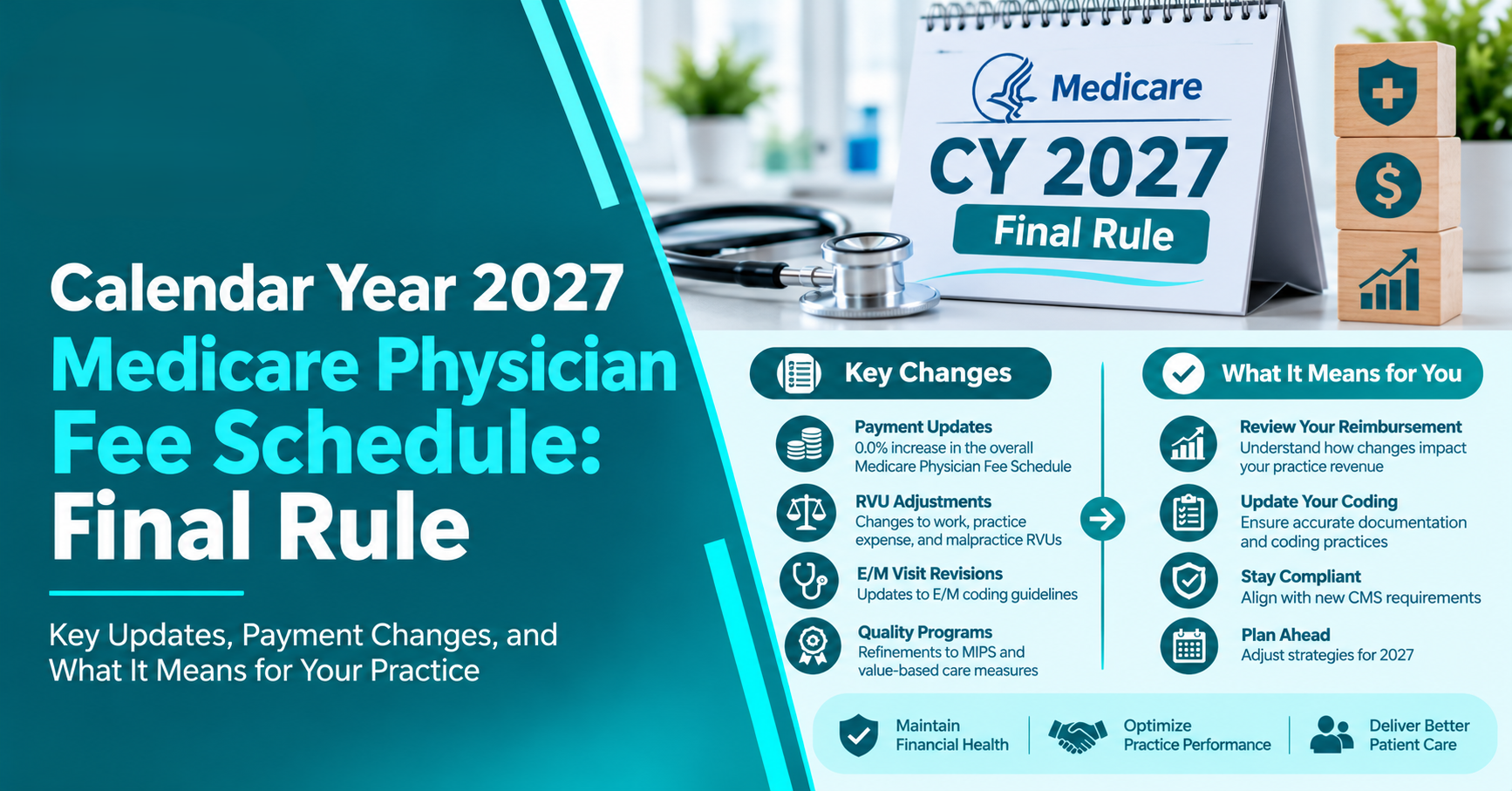
The Centers for Medicare & Medicaid Services (CMS) has finalized several changes to Medicare payment and policy under the Calendar Year (CY) 2027 Physician Fee Schedule (PFS). Most of the PFS provisions described in the CMS summary take effect January 1, 2027, although some policies have their own implementation dates.
For physician practices and other Medicare billing professionals, the rule is more than an annual payment update. The rule changes payment policies for certain evaluation and management (E/M) services performed alongside procedures. It replaces the separate G2211 add-on payment with modifiers, updates remote patient monitoring requirements, and revises reimbursement policies for primary care, behavioral health, rural health, and laboratory services.
This guide explains the finalized changes in practical terms. It also distinguishes between a policy CMS has finalized and an issue that CMS is still considering. That distinction matters: practices should prepare for confirmed requirements without changing claims workflows based on proposals or requests for public comment.
The Major Changes in Calendar Year 2027
| Policy area | What CMS finalized | Why providers should care |
| PFS conversion factors | $32.95 for qualifying APM participants and $32.63 for non-QPs | Expected payment amounts are lower than the respective CY 2026 factors. |
| Same-day E/M and procedures | Reduction applies to separately identifiable office/outpatient E/M with a 0-day global procedure; the lower-paid service is paid at 80%. | Review coding, claim edits, and reimbursement expectations for affected encounters. |
| G2211 | Transitions to modifier B1 for a 16% increase; B2 provides a 32% increase for eligible ACO/LEAD participants. | Update charge capture, eligibility checks, and claim systems. |
| RPM and RTM | Established-patient requirement for RTM and a separately reportable initiating visit for RPM/RTM; employed-clinical-staff restriction delayed to 2029. | Review patient onboarding, documentation, and vendor arrangements. |
| Practice expense | Phases out IPCI over two years and introduces a PE stabilizer. | Specialty payment assumptions may change as the methodology transitions. |
| Other services | New or revised payment policies affect shared appointments, behavioral health, CoCM, ACP, RHC/FQHC, labs, and more. | Identify which service lines and billing teams are affected. |
1. Medicare Physician Fee Schedule payment rates and conversion factors
The Physician Fee Schedule has governed Medicare payment for physician and other practitioner services since 1992. Payment is based on the resources required to furnish a service, represented through relative value units (RVUs) for practitioner work, practice expense, and malpractice expense. CMS applies geographic practice cost indices and a conversion factor to calculate payment rates.
For CY 2027, CMS will continue using two conversion factors: one for qualifying alternative payment model (APM) participants, commonly called QPs, and another for practitioners who are not QPs.
| Participant category | CY 2027 conversion factor | CY 2026 comparison factor | Change stated by CMS |
| Qualifying APM participants (QPs) | $32.95 | $33.57 | -$0.62 (-1.83%) |
| Non-qualifying APM participants | $32.63 | $33.40 | -$0.77 (-2.31%) |
CMS explains that the CY 2027 updates include the statutory 0.75% update for QPs and 0.25% update for non-QPs, along with an estimated -0.12% adjustment related to work RVU changes for certain services. The one-year 2.50% PFS increase provided for CY 2026 by Public Law 119-21 will not continue into CY 2027. CMS states that this results in a required 2.50% reduction compared with CY 2026.
The conversion factor is an important part of the payment calculation, but it is not a universal percentage reduction applied identically to every claim. Accurate Medicare billing also requires practices to apply the correct payment rules, service codes, and geographic adjustments to each claim. Actual allowed amounts depend on the service’s RVUs, geographic adjustments, site of service, and other applicable payment policies.
What practices should do
Reforecast Medicare revenue using the applicable 2027 conversion factor and the practice’s actual service mix. Do not estimate the impact using the conversion factor alone. Compare high-volume CPT and HCPCS services, specialties, and office versus facility settings. Update fee schedule files and financial projections when the applicable CMS payment files are available, and communicate expected changes to practice leadership.
2. Same-day E/M visits with 0-day global procedures
CMS finalized a narrower policy than the one it originally proposed. Beginning in CY 2027, when a separately identifiable office/outpatient E/M visit is furnished on the same day as a 0-day global procedure, the most expensive service will be paid at 100% and the other service or services will be paid at 80%.
CMS had proposed applying the reduction to E/M visits furnished with 0-, 10-, and 90-day global procedures, with the secondary service paid at 50%. After reviewing public comments, CMS limited the finalized policy to 0-day global procedures and increased the payment for the other service from the proposed 50% to 80%.
In practical terms, the policy does not mean that every E/M service performed on a procedure day is automatically reduced. The finalized rule described by CMS concerns a separately identifiable office/outpatient E/M service furnished on the same day as a 0-day global procedure. The most expensive of the services is paid in full; the other applicable service or services receive a 20% reduction.
What practices should review
· Identify procedure codes with 0-day global periods that are commonly billed with a separately identifiable office/outpatient E/M service.
· Review documentation to ensure the E/M service is separately identifiable and supported by the medical record.
· Test billing software and claim edits so the correct payment adjustment is applied to affected combinations.
· Train coding and billing staff on the finalized 80% policy. Do not carry forward the proposed 50% reduction or apply the policy to 10- or 90-day global procedures based on the proposal.
The CMS summary does not provide a complete code-by-code list or all claim-processing instructions. Practices should confirm the applicable procedure indicators and implementation guidance in the final rule and CMS payment files before changing individual code edits.
3. G2211 becomes modifier-based: B1 and B2
CMS is changing how the office/outpatient E/M complexity add-on currently associated with HCPCS code G2211 is reported. Starting in CY 2027, the separate G2211 add-on code will transition to a modifier appended to the associated E/M base code.
Modifier B1: 16% increase
Modifier B1 will increase payment for the associated E/M code by 16%. Unlike the previous flat-rate add-on approach, the percentage-based increase maintains the same proportional adjustment across E/M code levels. CMS expects this change to streamline billing and help beneficiaries understand their costs more easily.
Modifier B2: 32% increase for eligible ACO and LEAD participants
Modifier B2 will increase payment for the associated E/M visit by 32%. It is available only to practitioners participating in a Medicare Shared Savings Program Accountable Care Organization (ACO) or participant providers in a Long-term Enhanced ACO Design (LEAD) Model ACO.
CMS states that B2 is voluntary. Under the Shared Savings Program, providers may bill for all beneficiaries who receive services from an ACO participant or provider, not just those assigned to the ACO. Similarly, under the LEAD Model, participant providers may bill for all beneficiaries who receive their services, not just LEAD-aligned beneficiaries.
Both programs will include claims submitted with B2 in beneficiary assignment calculations, historical benchmark expenditures, and performance-year expenditures.
How to prepare for B1 and B2
Practices should plan a coordinated update across coding, charge capture, billing software, and compliance review. Confirm which clinicians and locations may report each modifier, how the modifier will be added to the E/M base code, and how the practice will prevent use of B2 by clinicians who are not eligible. Review payer and clearinghouse readiness as implementation instructions become available. Do not simply continue reporting G2211 in 2027 without checking the final CMS reporting requirements.
4. Remote physiologic monitoring and remote therapeutic monitoring
CMS finalized several changes for remote physiologic monitoring (RPM) and remote therapeutic monitoring (RTM) for CY 2027. These changes affect patient eligibility, the start of monitoring services, and how practices organize the work behind remote monitoring.
First, RTM services must be furnished only to established patients. Second, practitioners reporting RPM or RTM must furnish a separately reportable initiating visit in association with the start of RPM or RTM services. Third, CMS finalized updates to how these services are valued under the PFS.
CMS also finalized a policy that would limit payment to RPM or RTM services performed by clinical staff employed by the practice, rather than contractors. However, CMS delayed this requirement for two years. It will take effect January 1, 2029, giving practices additional time to adapt.
Operational implications
Practices should review how patients are selected and enrolled, how the initiating visit is scheduled and documented, and how the start of monitoring is recorded. RTM workflows should include a reliable process to confirm established-patient status. Practices using outside monitoring vendors or contracted personnel should map which tasks are performed by the vendor and which are performed by the practice’s own staff.
The employment restriction is not a CY 2027 requirement under the finalized timeline described by CMS. Practices should not treat the delayed 2029 date as an immediate reason to stop using contractors, but they should use the transition period to assess staffing, contracts, and operating models.
CMS also sought comment on potentially bundling RPM and RTM CPT codes and creating four new HCPCS G-codes. The summary says CMS may consider the comments in future rulemaking. This is not a finalized coding change in the CY 2027 summary.
5. Practice expense methodology changes
Practice expense is one of the three resource components used to calculate PFS payment. CMS has historically relied on AMA survey data to estimate physician work, direct practice expense inputs, and overall practice expense. CMS says it is moving toward more objective, routinely updated, and auditable cost data because survey response rates and differences in data collection can create limitations.
For CY 2027, CMS finalized a two-year phase-out of the indirect practice cost index (IPCI). The IPCI had helped keep the overall number of practice expense RVUs by specialty consistent with older specialty-specific practice expense per hour data. CMS will replace it with a practice expense stabilizer intended to reduce short-term volatility without anchoring values to a specific historical point.
CMS also finalized a change to allocate indirect practice expense using both work RVUs and clinical labor practice expense RVUs, rather than only the maximum of the two, for codes other than 10- and 90-day global period codes. It also finalized an adjustment to indirect practice expense allocation for visits furnished to beneficiaries during a Part A skilled nursing facility stay, consistent with the site-of-service payment differential policy finalized in the CY 2026 PFS rule.
These are methodology changes, not a single across-the-board payment increase or decrease for every specialty. Their impact will depend on the services and specialties involved as the transition takes place. A medical billing audit can help practices review reimbursement patterns, identify payment discrepancies, and uncover billing issues affecting revenue.
What this means for practices
Specialty groups should monitor changes to their individual service-level payment rates rather than assume that the conversion factor tells the whole story. When CMS releases detailed payment files, compare affected codes and model the effect on the practice’s service mix. CMS received comments about whether the facility and non-facility payment differential remains appropriate; the agency says it will consider those comments in future rulemaking. That issue should not be described as a finalized change in this rule.
6. Primary care, chronic illness, and behavioral health
Shared medical appointments
CMS finalized separate coding and payment for shared medical appointments and an add-on code to account for additional time. Shared medical appointments allow patients to receive clinical guidance in a group setting while also interacting with others facing similar health concerns. CMS identifies potential benefits such as multidisciplinary support, patient engagement, and addressing social isolation. Practices interested in this model should review the final code descriptors, documentation requirements, and billing instructions before implementing it.
Smoking cessation and SBIRT services
CMS finalized the inclusion of smoking and tobacco use cessation services and structured assessment, brief intervention, and referral to treatment (SBIRT) services in the final year of the transition that applies to increased work RVUs for timed behavioral health codes. The change follows the earlier increase in valuation for timed psychotherapy services finalized in the CY 2024 PFS rule.
Psychiatric Collaborative Care Model
For the Psychiatric Collaborative Care Model (CoCM), CMS finalized increases to work RVUs and updates to clinical labor rates for the Behavioral Health Care Manager. These refinements affect how CoCM services are valued under the PFS. Practices furnishing collaborative behavioral health services should check the final valuation and payment files for the codes they report.
Vaccine adverse-effect evaluation and treatment
CMS finalized add-on coding and payment for work beyond what is captured in an E/M visit when diagnosing and treating vaccine adverse effects. The described work can include listening to patient concerns, answering questions, building trust, selecting an appropriate diagnostic approach, communicating in a way that reflects the patient’s concerns and health literacy, providing resources, and planning symptom treatment. Practices should distinguish this additional work from services already represented by the E/M code and follow the final code requirements.
Practical point
These policies create opportunities to review service design and documentation, but a new payment pathway does not remove the need to meet code-specific requirements. Before billing, confirm who may furnish the service, what must be documented, whether time thresholds apply, and whether the service can be reported with other services on the same date.
7. Advance care planning: new clinical-staff G-codes
CMS finalized two new HCPCS codes, G0572 and G0573, for advance care planning (ACP) services furnished by clinical staff under the direct supervision of the billing physician or other practitioner.
CMS is also finalizing a distinction between the existing ACP CPT codes 99497 and 99498 and the new G-codes. Billing practitioners will use CPT codes 99497 and 99498 only to report the time they personally spend providing services. The new G-codes will separately identify and account for clinical staff work and the time billing practitioners spend on these services.
Practices should review how ACP time is currently recorded and who performs each part of the service. Documentation and charge capture should clearly distinguish practitioner time from clinical-staff time, and workflows should reflect the direct-supervision condition described by CMS.
8. Rural Health Clinics and Federally Qualified Health Centers
CMS finalized a policy that allows Rural Health Clinics (RHCs) to provide and bill for Diabetes Self-Management Training (DSMT) and Medical Nutrition Therapy (MNT) as stand-alone preventive visits under the RHC benefit. RHCs can receive payment for these services at the all-inclusive rate when a certified provider delivers them under the direct supervision of an RHC practitioner.
CMS also finalized conforming changes related to the Consolidated Appropriations Act, 2026. The in-person visit requirement for mental health visits will not apply to services furnished through December 31, 2027. The authority for CMS to pay RHCs and FQHCs for non-behavioral health visits furnished through telecommunication technology is also extended through December 31, 2027.
RHCs and FQHCs should review service eligibility, provider qualifications, supervision, and billing workflows. They should also track the stated end date for the temporary telecommunication policies and avoid assuming that the extensions automatically continue beyond 2027.
9. Clinical Laboratory Fee Schedule updates
CMS finalized changes to the Clinical Laboratory Fee Schedule (CLFS) to implement amendments made by the Consolidated Appropriations Act, 2026. The changes address data collection, data reporting, and the phase-in of payment reductions for clinical diagnostic laboratory tests (CDLTs).
For non-advanced diagnostic laboratory tests, the most recent data reporting period described by CMS ran from May 1 through July 31, 2026, using applicable information collected from January 1 through June 30, 2025. Beginning in CY 2027, payment reductions resulting from CLFS rates based on private payer data will be limited to 15% per year through CY 2029.
Laboratories should confirm which reporting category applies to each test, maintain the records needed for applicable reporting, and model the impact of the annual reduction cap on their test mix. The 15% limit is an annual cap on the specified payment reductions, not a statement that every laboratory test will be reduced by 15%.
10. Medicare Part B and Part D drug inflation rebate reporting, including 340B claims
The final rule includes policies for the Medicare Prescription Drug Inflation Rebate Program, which covers Part B and Part D. Among other clarifications, CMS explains which Consumer Price Index for All Urban Consumers (CPI-U) data providers should use to establish a benchmark period for subsequently approved drugs when the relevant CPI-U data are unavailable.
The rule also requires providers and suppliers that qualify as covered entities under 42 CFR 10.3 to submit specific data elements to the Medicare Part D Claims Data 340B Repository. This requirement applies when a covered entity or its contractor, such as a contract pharmacy, dispenses units of a covered Part D drug, bills Medicare Part D, and receives a 340B discount from the manufacturer.
The reporting requirement applies to claims with dates of service on or after January 1, 2027. CMS delayed the first mandatory quarterly submission deadline for claims dated January 1 through March 31, 2027, until September 30, 2027.
Covered entities should identify affected Part D claims, determine the required data elements, and coordinate reporting responsibilities with contract pharmacies and other dispensing contractors. The delayed first submission deadline does not remove the underlying requirement for applicable claims.
11. Medicare eligibility changes under Public Law 119-21
CMS finalized regulations implementing statutory changes that limit Medicare eligibility to specified groups. The groups described in the CMS summary are: U.S. citizens or nationals; individuals lawfully admitted for permanent residence under the Immigration and Nationality Act; individuals granted Cuban and Haitian entrant status; and individuals lawfully residing in the United States under a Compact of Free Association.
CMS is updating regulations to address eligibility, termination procedures, applicable appeal rights, and enrollment options for individuals who later gain or regain eligibility.
For providers, this is an area where eligibility verification and patient communication may become especially important. Practices should use current Medicare eligibility information and established payer processes rather than making assumptions based on a patient’s appearance, name, language, or other personal characteristics. When coverage status is unclear, follow the applicable Medicare verification and appeal processes.
12. Duplicate laboratory testing, imaging, and interoperability: what is not yet finalized
CMS requested information on ways to reduce duplicate laboratory testing and diagnostic imaging and improve the sharing of results across care settings. CMS notes that test results can remain siloed in the electronic health record system of the organization that ordered or performed the test. When treating providers cannot access existing results, patients may undergo unnecessary repeat testing, experience delays, or receive avoidable radiation exposure.
CMS received stakeholder feedback supporting efforts to reduce duplicative testing while preserving access to necessary care and improving interoperability. The summary says CMS may consider this feedback in future rulemaking.
This is a request for information and a topic for potential future action, not a new finalized billing requirement in the summary. Nevertheless, practices can review how they obtain outside records, share results, and check for prior imaging or laboratory work when clinically appropriate.
13. A practical CY 2027 readiness plan for medical practices
The most effective way to prepare is to translate the final rule into specific workflow changes. An effective revenue cycle management process helps practices coordinate these updates across coding, claim submission, payment tracking, and denial follow-up. A practice does not need to overhaul every process at once. It should first identify which finalized policies affect the services it actually furnishes and bills.
1. Map exposure by service line. List the Medicare services, specialties, locations, and provider types that may be affected by the new payment and coding policies.
2. Recalculate expected Medicare reimbursement. Use the correct QP or non-QP conversion factor and review service-level RVUs, geographic adjustments, and site-of-service differences.
3. Update coding and billing rules. Prepare for the 0-day global procedure payment adjustment and the transition from G2211 to modifiers B1 and B2.
4. Validate remote monitoring workflows. Confirm established-patient status for RTM, the initiating visit process for RPM and RTM, and the plan for the 2029 clinical-staff employment requirement.
5. Review documentation and staff responsibilities. Pay particular attention to separately identifiable E/M services, advance care planning time, shared medical appointments, and services furnished by clinical staff. Reviewing recurring denial patterns can also help practices identify documentation and coding issues before they affect more claims.
6. Coordinate with vendors and clearinghouses. Confirm software updates, modifier handling, claim edits, and reporting capabilities before the effective dates.
7. Train the right teams. Coding, billing, clinical operations, credentialing, finance, and compliance staff may each need different parts of the update.
8. Monitor CMS implementation materials. Use the final regulation, code files, fee schedule files, and subsequent CMS instructions for code-level decisions. Update internal policies when authoritative implementation details are released.
FAQs
Q1- When do the CY 2027 Medicare PFS changes take effect?
Most PFS policies in the CMS summary apply on or after January 1, 2027. Some provisions have separate timelines. For example, the RPM/RTM clinical-staff employment restriction is delayed until January 1, 2029, while the first 340B Repository submission for Q1 2027 claims is due September 30, 2027.
Q2- What are the CY 2027 Medicare PFS conversion factors?
CMS lists $32.95 for qualifying APM participants and $32.63 for practitioners who are not qualifying APM participants. These are lower than the respective CY 2026 factors of $33.57 and $33.40.
Q3- Does the same-day E/M reduction apply to all global surgery periods?
No. CMS finalized the reduction for a separately identifiable office/outpatient E/M visit furnished on the same day as a 0-day global procedure. CMS did not finalize the proposed extension to 10- and 90-day global procedures in the summary.
Q4- Will the secondary service be paid at 50%?
No. The proposed 50% reduction was changed in the final policy. The most expensive service is paid at 100%, and the other applicable procedure or E/M service is paid at 80%.
Q5- What replaces G2211 in 2027?
CMS is transitioning the separate G2211 add-on to modifier B1, which increases the associated E/M payment by 16%. Eligible Shared Savings Program ACO and LEAD Model participants may voluntarily use modifier B2 for a 32% increase, subject to CMS requirements.
Q6- Can RTM be billed for new patients in 2027?
CMS finalized a requirement that RTM services be furnished only to established patients. Practices should verify established-patient status before reporting RTM.
Q7- Must RPM and RTM be performed by employed clinical staff in 2027?
No. CMS delayed that finalized restriction for two years. It is scheduled to take effect January 1, 2029.
Q8- Are the proposed RPM/RTM bundled codes and four new G-codes finalized?
The CMS summary describes this as a request for comment. CMS may consider the feedback in future rulemaking; it is not presented as a finalized CY 2027 coding change.
Q9- What changed for advance care planning?
CMS finalized new G-codes G0572 and G0573 for certain ACP services furnished by clinical staff under the billing practitioner’s direct supervision. CPT 99497 and 99498 will report only time personally spent by the billing practitioner.
Q10- What should RHCs know about DSMT and MNT?
CMS finalized recognition of these services as qualified preventive services that may be covered and paid as stand-alone billable visits under the RHC benefit at the all-inclusive rate, subject to certification and direct-supervision conditions.
How PHCS can help practices manage the billing impact
A Medicare payment policy update can affect more than the fee schedule. New modifiers, revised payment logic, documentation expectations, and reporting responsibilities can create gaps between what a practice performs and what its claims communicate.
Proactive Healthcare Services supports healthcare practices with medical billing and revenue cycle management services, including claim preparation, coding and billing workflow review, denial follow-up, payment analysis, and revenue cycle support. As practices prepare for CY 2027, a focused review can help identify affected services, assess whether billing workflows reflect finalized CMS requirements, and flag claim patterns that may need attention.
The right starting point is a review of the practice’s Medicare service mix and current billing processes. From there, teams can prioritize fee schedule updates, modifier implementation, documentation checks, staff education, and follow-up on underpayments or denials. PHCS can help practices strengthen these operational processes so that policy changes are translated into accurate, consistent billing workflows.
For support with medical billing, revenue cycle management, or a review of billing workflows, contact Proactive Healthcare Services.
Conclusion: prepare for the changes that are finalized
The CY 2027 Medicare PFS Final Rule includes important changes to payment rates, same-day E/M billing, G2211 reporting, remote monitoring, practice expense methodology, and several service-specific payment policies. Some changes will require direct claim and documentation updates; others call for financial forecasting, staff planning, or closer monitoring as CMS releases implementation details.
Practices should distinguish between policies that take effect in 2027 and those CMS has delayed or reserved for future consideration. By identifying potential impacts early, updating relevant workflows, and verifying implementation details against CMS instructions, practices can manage reimbursement accurately and reduce preventable billing disruptions.