
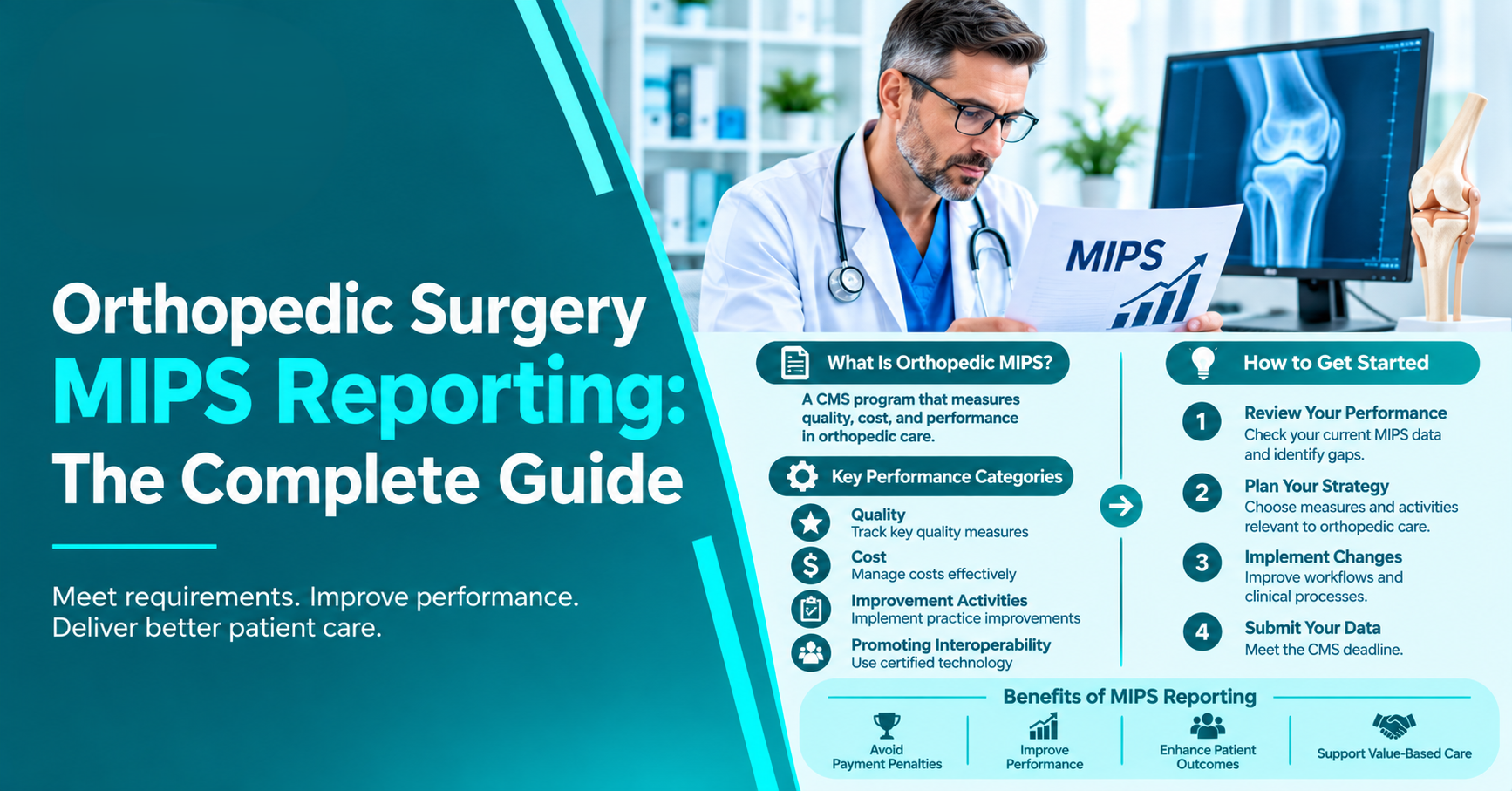
| Orthopedic surgery MIPS reporting is the yearly process of sending CMS data on quality, cost, improvement activities, and Promoting Interoperability so your Medicare Part B payments can be adjusted up or down. For the 2027 performance year, orthopedic practices can report through traditional MIPS or the Improving Care for Lower Extremity Joint Repair MIPS Value Pathway (MVP). Each clinician must report at least one core quality measure. A final score of 75 points or higher avoids a penalty, and adjustments range from minus 9 percent to plus 9 percent. Traditional MIPS ends after the 2030 performance year. |
What Changed for Orthopedic Surgery MIPS Reporting in 2027
CMS released the final 2027 rule on November 4, 2026. The table below sorts the changes that matter most to orthopedic practices by how certain each one is.
| Topic | What CMS did | Status |
| End of traditional MIPS | Traditional MIPS ends beginning with the 2031 performance period. Clinicians have through 2030 to move to MVPs or Advanced APMs. The proposal had been 2029 | Finalized |
| Core measure requirement | Starting in 2027, one of your quality measures must be a core measure. This replaces the old outcome or high priority requirement | Finalized |
| Core measure details | The list of 78 core measures, the small practice exemption, and the option to attest when no core measure applies | Proposed |
| Joint Repair MVP measures | Core measures 351, 470, and 480, and removal of measure 350 from the MVP | Proposed |
| Orthopedic functional measures | Replace seven FOTO-based functional status measures (217 to 222 and 478) with five PROMIS-based functional improvement measures | Proposed |
| Security Risk Analysis measure | Remove the measure from Promoting Interoperability starting in 2027. HIPAA still requires the analysis | Proposed |
| New MVPs | Three new MVPs for diabetes, hypertension, and hospitalists. None is built for orthopedics | Finalized |
| Performance threshold | Stays at 75 points through the 2028 performance year | Finalized |
| Ambulatory Specialty Model | CMS finalized updates to the model as a package. Item-level details, such as the lumbar MRI measure and rural scoring adjustment, come from the July proposal | Finalized as a package |
| Payment rates | Conversion factor of $32.63 for most clinicians (down 2.31%) and $32.95 for qualifying APM participants (down 1.83%) | Finalized |
| Billing rules | A same-day office visit billed with a 0-day global procedure is paid at 80% (10-day and 90-day globals were left out). G2211 becomes modifier B1 (+16%). Required postoperative visit data collection (CPT 99024) is paused | Finalized |
| Why this matters: Traditional MIPS is not going away tomorrow, but it now has an end date. Practices that learn MVP reporting during 2027 and 2028 will be ready long before the 2031 cutoff. |
What Is Orthopedic Surgery MIPS Reporting?
MIPS stands for the Merit-based Incentive Payment System. It is the Medicare program that raises or lowers your Part B payments based on the quality and cost of the care you provide. Orthopedic surgery MIPS reporting is the work of collecting that data for your orthopedic patients and sending it to CMS each year.
CMS scores you in four areas called performance categories: Quality, Cost, Improvement Activities, and Promoting Interoperability. Each category earns points, and the points combine into a final score from 0 to 100. A score below 75 results in a payment penalty. At exactly 75 points, you receive no adjustment to your payment. However, scoring above 75 can qualify you for a positive payment adjustment.
| MIPS fact | 2027 performance year |
| Performance period | January 1 to December 31, 2027 |
| Payment year affected | 2029 Medicare Part B payments |
| Performance threshold | 75 points (set through the 2028 performance year) |
| Payment adjustment range | Minus 9 percent to plus 9 percent |
| Category weights | Quality 30%, Cost 30%, Improvement Activities 15%, Promoting Interoperability 25% |
| Quality data completeness | 75 percent of eligible cases for each measure (set for 2027 and 2028) |
| Expected data submission window | Early 2028, closing March 31, 2028 (confirm on QPP) |
| Last year of traditional MIPS | 2030 performance year |
Why MIPS Matters So Much in Orthopedics
Orthopedic surgeons treat many Medicare patients. Joint replacements, fracture care, and spine procedures make up a large share of that work, so even a small percentage change adds up fast.
Take a surgeon who receives $500,000 a year in Medicare Part B payments. A 9 percent penalty costs that surgeon $45,000 every year it applies. A group with ten such surgeons would lose $450,000. That is why a clear reporting plan is worth the effort.
| Why this matters: MIPS works on a two year delay. What you report for 2027 changes your 2029 payments. The 2026 year is still open: its data is due March 31, 2027, and the 2026 rules, including the old outcome or high priority measure requirement, still apply to it. |
What Makes Orthopedic MIPS Different
Orthopedics has its own measures, its own cost measures, and its own MVP. The joint replacement measures cover shared decision making, risk evaluation, and functional status, and the cost category includes Knee Arthroplasty and Elective Primary Hip Arthroplasty.
2027 MIPS Requirements for Orthopedic Surgeons
The table below shows what traditional MIPS asks for in the 2027 performance year. The category weights and day counts are the same as 2026. The main change is in Quality, where a core measure is now required.
| Category | Weight | What you do | How long |
| Quality | 30% | Report 6 measures, including 1 core measure | 12 months |
| Cost | 30% | Nothing to submit. CMS uses your claims | 12 months |
| Improvement Activities | 15% | Attest to 2 activities (1 if small, rural, or in a HPSA) | 90 continuous days |
| Promoting Interoperability | 25% | Report the required measure set with certified EHR technology | 180 continuous days |
Quality Category (30 Percent)
This is where most orthopedic practices spend their time. You pick six quality measures and collect data for the full calendar year. In the past, one of the six had to be an outcome measure or a high priority measure. Starting in 2027, one of the six must be a core measure instead.
CMS defines a core measure as a measure it considers fundamental to a specialty. CMS has finalized the core measure requirement, but the following implementation details come from its July proposal and remain proposed: CMS identified 78 measures as core, proposed exempting small practices, and allowed clinicians without an applicable core measure to attest to that and select another measure. The proposal also assigns a zero score to any required core measure that a clinician does not submit. You can find the proposed core measures for the Joint Repair MVP in the MVP section.
CMS expects you to report on at least 75 percent of the eligible cases for each measure. This is called data completeness. Each measure that meets data completeness and the case minimum can earn 1 to 10 points based on how your performance compares with benchmarks.
You can send quality data in a few ways. MIPS Clinical Quality Measures (CQMs) go through a registry or qualified clinical data registry. Electronic clinical quality measures (eCQMs) come from certified EHR technology. Small practices may also use Medicare Part B claims measures. Many of the best orthopedic measures, such as 350, 351, 358, and 470, are available only as MIPS CQMs. That means most orthopedic practices need a registry or reporting partner.
| Note: For MIPS CQMs and eCQMs, your data should cover all patients who qualify for the measure, whatever their insurance. Only Medicare Part B claims measures are limited to Medicare Part B patients. Many practices lose points because they report only Medicare patients. |
Cost Category (30 Percent)
You do not submit anything for cost. CMS calculates it from your Medicare claims. For orthopedics, this can include Knee Arthroplasty and Elective Primary Hip Arthroplasty, along with broader measures such as Total Per Capita Cost. You are scored only on cost measures where you meet the case minimum. CMS did not propose changes to the cost measure list for 2027.
Because you cannot submit cost data, your best tools are clean claims, accurate coding, and good care coordination before and after surgery. Cost scoring is one of the main reasons billing accuracy and MIPS work together.
Improvement Activities (15 Percent)
You attest that you completed activities from CMS’s list for at least 90 continuous days. Most practices choose two. Small practices, rural practices, practices in health professional shortage areas, and non-patient-facing clinicians attest to one.
Activities that fit orthopedic care well include using evidence-based decision aids to support shared decision making (IA_BE_12), promoting the use of patient-reported outcome tools (IA_BE_26), and measurement and improvement at the practice and panel level (IA_PSPA_18). CMS proposed adding six activities and removing eleven for 2027, so check the current list before you choose.
| Practical tip: Plan your 2027 activities in January. A 90 day activity must start by October 3 to finish before December 31. |
Promoting Interoperability (25 Percent)
This category is about how you use certified EHR technology. You report a required measure set for at least 180 continuous days. It includes e-prescribing, patient access to health information, health information exchange, and public health reporting.
Two 2027 changes are proposed. The Security Risk Analysis measure would be removed from the category, and the Electronic Prior Authorization measure would become an optional bonus in 2027 and a required measure from 2028.
| Important: Even if the Security Risk Analysis measure leaves MIPS (proposed), the HIPAA Security Rule still requires every covered entity to complete a security risk analysis. Keep doing it every year. |
Some clinicians get this category reweighted to zero. Small practices receive automatic reweighting. Hospital-based clinicians, ambulatory surgical center (ASC) based clinicians, and non-patient-facing clinicians can also qualify. This matters in orthopedics because many surgeons do most of their work in surgery centers or hospitals. Check your status on the QPP participation lookup before assuming you must report.
How Reweighting Changes Your Score
When CMS reweights a category, it redistributes that category’s points among the remaining categories. If a small practice does not submit Promoting Interoperability data, CMS assigns 40% to Quality, 30% to Cost, and 30% to Improvement Activities. For a larger practice in the same situation, CMS assigns 55% to Quality, 30% to Cost, and 15% to Improvement Activities. As a result, each Quality measure carries greater weight when CMS removes the Promoting Interoperability category.
Scoring, Penalties, and Deadlines
CMS has kept the performance threshold at 75 points through the 2028 performance year. Data for 2027 is submitted after the year ends, and the deadline is expected to be March 31, 2028. CMS then sends feedback reports and payment adjustments that start in 2029. If you disagree with your score, you can ask for a targeted review within the window CMS provides.
Who Is Eligible for MIPS in an Orthopedic Practice?
Three things decide whether you must report. You must be an eligible clinician type, you must exceed the low-volume threshold, and you must not fall under an exclusion.
Eligible Clinician Types in Orthopedics
Physicians, physician assistants, and nurse practitioners are the clinicians most orthopedic practices have. All three are eligible clinician types. Physical and occupational therapists in your practice are also eligible clinician types.
The Low-Volume Threshold
To be required to report, you must exceed all three of these: more than $90,000 in Medicare Part B allowed charges, more than 200 Medicare Part B patients, and more than 200 covered professional services. CMS checks this across two 12-month periods. For the 2027 performance year, those periods are expected to run October 1, 2025 to September 30, 2026, and October 1, 2026 to September 30, 2027. Confirm the exact dates on the QPP site.
Who Is Excluded
You are excluded if you enrolled in Medicare for the first time during the performance year, if you are a Qualifying APM Participant in an Advanced Alternative Payment Model, or if you do not exceed the low-volume threshold in either period. If you meet one or two of the three low-volume points, you may opt in, but opting in is a one-way choice for the year and can bring a penalty as well as a bonus.
| Practical tip: Eligibility is checked by clinician (NPI) and by practice (TIN). One surgeon may need to report while a colleague does not. Use the QPP participation lookup for every clinician each year. |
Note: A surgeon in the Ambulatory Specialty Model is exempt from MIPS during the ASM years. See the ASM section for details.
MIPS Reporting for Independent Orthopedic Practices
Independent practices carry the full reporting load without a hospital quality department. The good news is that you have more control over how you report.
Choose How You Will Be Scored
You can report as an individual, as a group under your TIN, or through a virtual group. Group reporting gives the whole practice one final score. Individual reporting scores each surgeon separately. Many practices choose group reporting because it saves work, but a strong surgeon and a weaker one will then share the same result.
Small Practice Advantages
A small practice has 15 or fewer clinicians under the TIN. CMS provides several reporting flexibilities for these practices. It automatically reweights the Promoting Interoperability category, requires only one improvement activity, and allows Medicare Part B claims measures for Quality reporting. CMS has also proposed an exemption from the core measure requirement for small practices.
Choose Your Submission Method
Independent practices usually submit through one of three routes. A registry or Qualified Clinical Data Registry (QCDR) collects measure data and sends it to CMS. The AAOS Registry Program, including the American Joint Replacement Registry (AJRR), can support quality reporting for participants. Your EHR vendor may also submit eCQMs. A reporting company can handle the full process.
Common Challenges for Independent Practices
Staff time is the biggest barrier. Collecting patient-reported outcome scores at the right moments, such as before surgery and one year after, takes a clear workflow. Independent practices also struggle with limited analytics and with tracking follow-up visits across many surgeons.
Traditional MIPS vs. Orthopedic Surgery MVP: Key Differences
CMS does not have a separate program called the Orthopedic Surgery MVP. The MVP built for orthopedic surgeons is named Improving Care for Lower Extremity Joint Repair. It is a different way to report the same MIPS program, with a smaller, more focused set of measures.
| Area | Traditional MIPS | Lower Extremity Joint Repair MVP |
| Quality measures | 6 measures of your choice, including 1 core measure | 4 measures from the MVP list, including 1 core measure |
| Improvement activities | 2 (1 for small, rural, or HPSA practices) | 1 from the MVP list for everyone |
| Cost | Any cost measure where you meet the case minimum | Only Knee Arthroplasty and Elective Primary Hip Arthroplasty, where case minimums are met |
| Population health | Not used | CMS scores two claims-based measures and uses the higher one in Quality |
| Promoting Interoperability | Required measure set | Same required measure set |
| Registration | Not required | Required with CMS before the deadline for that year |
| Flexibility | Pick any measures you like | One MVP only, and no changes after registration closes |
| Future | Ends after the 2030 performance year | Becomes the main pathway |
Which Option Is Better?
There is no single right answer for 2027. The MVP is a better fit when most of your work is hip and knee replacement, because the measures and cost scoring match your cases. Traditional MIPS is better when your practice is broad, such as sports medicine, hand, and trauma together. Since traditional MIPS now has an end date, many practices will benefit from trying the MVP once while the rules are still flexible.
| Important: MVP registration for 2026 closes on November 30, 2026 at 8 p.m. ET. If you did not register, report traditional MIPS for 2026. For 2027, CMS has opened registration in the spring and closed it at the end of November in 2026. Confirm the 2027 dates on the QPP site. |
Improving Care for Lower Extremity Joint Repair MVP: Complete Guide
The Improving Care for Lower Extremity Joint Repair MVP (MVP ID G0058) covers the care of patients with osteoarthritis and lower extremity surgical repair, including fracture care and total joint replacement. CMS lists orthopedic surgery as the specialty most suited to it.
What Is Included
The MVP groups four things together: a short list of quality measures, a short list of improvement activities, two cost measures, and a foundation layer. The foundation layer holds the population health measures and the same Promoting Interoperability requirements used in traditional MIPS.
Who Can Report It
Individual clinicians and single specialty groups can report an MVP. Practices register as a group by stating whether they are a single specialty group or a small multispecialty practice. Larger multispecialty groups must form subgroups, so an orthopedic group inside a bigger multispecialty organization would register as a subgroup.
How Registration Works
You register on the QPP website with a HARP account. During registration you select the MVP, any administrative claims outcome measure you want to be scored on, and whether you will report as an individual, group, subgroup, or APM entity. Subgroups also provide a list of clinicians, a plain-language name for public reporting, and a description of the subgroup.
After registration closes you cannot change your MVP, report a different MVP, or report more than one MVP in the same year.
How the MVP Is Scored
The category weights stay the same as traditional MIPS: Quality 30 percent, Cost 30 percent, Improvement Activities 15 percent, and Promoting Interoperability 25 percent. The population health measures count inside the Quality category. CMS calculates both and applies the higher result, if you meet the case minimum.
What Changes in 2027
CMS proposed adding core measure selections to all 27 existing MVPs. The proposed selections for this MVP, and the proposed removal of measure 350, appear in the measures table in the next section.
2027 Lower Extremity Joint Repair MVP Measures and Requirements
Quality Measures
You report four measures from the MVP list, and one must be a core measure. The table shows the 2026 MVP list with the 2027 proposals noted. You collect data for the full year.
| ID | Measure | Type | Collection | 2027 note |
| 024 | Communication with the physician managing ongoing care after a fracture (age 50 and older) | Process | MIPS CQM, Part B claims | No change proposed |
| 128 | BMI screening and follow-up plan | Process | eCQM, MIPS CQM, Part B claims | No change proposed |
| 350 | Total knee or hip replacement: shared decision making and trial of conservative therapy | Process | MIPS CQM | Proposed for removal from this MVP |
| 351 | Total knee or hip replacement: venous thromboembolic and cardiovascular risk evaluation | Process | MIPS CQM | Proposed core measure |
| 376 | Functional status assessment for total hip replacement | Process | eCQM | No change proposed |
| 470 | Functional status after primary total knee replacement | Patient reported outcome | MIPS CQM | Proposed core measure |
| 480 | Risk-standardized complication rate after elective primary hip or knee replacement | Outcome | Administrative claims | Proposed core measure |
| Note: Measure 480 is calculated by CMS from claims. If you want it counted as one of your four, you must select it during MVP registration. Small practices that report quality through Part B claims can meet the quality requirement by reporting the Part B claims measures in the MVP. |
Improvement Activities
You attest to one activity for at least 90 days. The 2026 list includes regularly assessing patient experience of care (IA_BE_6), using evidence-based decision aids (IA_BE_12), promoting patient-reported outcome tools (IA_BE_26), care coordination training (IA_CC_7), regular individual care plans (IA_CC_9), OpenNotes practices (IA_CC_13), and use of QCDR data for practice improvement (IA_PSPA_7), among others. The 2027 activity list may differ, so confirm before you attest.
Cost Measures
CMS evaluates two cost measures: Knee Arthroplasty and Elective Primary Hip Arthroplasty. You do not select these measures. CMS scores you only on the measures for which you meet the minimum case requirement. This approach prevents surgeons from receiving scores on cost measures that do not reflect their practice.
Population Health Measures
CMS calculates two claims-based measures: the Hospital-Wide 30-Day All-Cause Unplanned Readmission Rate and the Clinician and Clinician Group Risk-Standardized Hospital Admission Rates for Patients with Multiple Chronic Conditions. CMS then uses the higher result to calculate your Quality score.
Promoting Interoperability
The requirements are the same as traditional MIPS. Reweighting still applies if you qualify for it.
How Orthopedic Surgeons Can Prepare for Joint Repair MVP Reporting
Good preparation starts with an honest look at your own data. Use these steps as a working plan for 2027.
1. Count your cases. Pull one year of volume for total knee, total hip, fracture, and spine procedures. A measure with too few cases earns nothing.
2. Check your registry or EHR. Confirm that your system can collect 351, 376, and 470 for MVP reporting in 2027, and ask about 350, since it may leave the MVP.
3. Map your workflow. Decide who captures the shared decision making note, the risk evaluation, and the patient-reported outcome scores, and where each lives in the chart.
4. Plan your follow-up visits. Measure 470 looks at function about one year after surgery. A patient who misses that window cannot help your score.
5. Pick an improvement activity and check your claims. Choose something you already do, such as decision aids. Cost scoring uses your claims, so coding and documentation should be clean before you register.
6. Register on time. Sign in to QPP with your HARP account and finish registration before the deadline.
| Practical tip: Run a mock report for three months of past data. It shows quickly which measures your team can really support and which ones only look easy on paper. |
How to Select Quality Measures for the Lower Extremity Joint Repair MVP
Choose measures that fit your patients, your systems, and your goals. First, confirm you meet the case minimum. Second, confirm your registry or EHR can collect the measure. Third, confirm you can reach 75 percent data completeness. Fourth, check the benchmark to see how hard it is to score well. Finally, make sure one of your measures is a core measure.
| If your practice is mostly… | Consider these measures | Why |
| Hip and knee replacement | 351, 470, 376, 480 (and 350 in traditional MIPS) | They follow the whole joint replacement journey, and three are proposed core measures |
| Fracture and trauma care | 024, 128 | 024 is simple when a referral note is routine |
| Small group using claims | 024 and 128 | These are the Part B claims options in the MVP |
| Mixed practice wanting low effort | 128 and 024 plus one joint measure | Process measures take less follow-up |
MIPS Reporting for Total Knee Replacement and Hip Replacement
Joint replacement is where orthopedic MIPS can reward good habits the most. The table shows how the measures follow a patient from the first visit to one year after surgery. Each measure is explained in its own section below.
| Stage | What CMS looks for | Related measure |
| Before the decision | Shared decision making and a trial of non-surgical care documented | 350 |
| Within 30 days before surgery | Evaluation for blood clot and cardiovascular risk factors | 351 |
| Before surgery (non-emergency) | Personal risk assessment using a clinical data-based risk calculator, discussed with the patient | 358 |
| Within 90 days before and 300 to 425 days after hip replacement | Functional status assessment | 376 |
| About 1 year after knee replacement | Patient-rated function at or above the target score | 470 |
| Up to 90 days after surgery | CMS measures complications from claims | 480 and cost measures |
The difficult part is the one-year follow-up, because many patients do not return after they recover. A text or email reminder with a survey link often works better than waiting for an office visit.
| Note: CMS finalized a mandatory nationwide bundled payment model for lower extremity joint replacement, called CJR-X, in the FY 2027 hospital payment rule. It starts January 1, 2028, after CMS delayed it from October 1, 2027. It covers hip, knee, and ankle replacement episodes through 90 days after discharge. Hospitals will hold the episode, so expect closer talks with surgeons about complications, readmissions, and post-acute care. |
Osteoarthritis Management and MIPS Reporting for Orthopedic Practices
Although the Joint Repair MVP includes osteoarthritis in its clinical theme, it does not have a separate osteoarthritis measure. Instead, three measures address key aspects of osteoarthritis care: measure 350 evaluates shared decision-making and attempts at non-surgical treatment before joint replacement; measure 128 tracks BMI screening and follow-up to support weight management; and measure 182 assesses patients’ functional outcomes.
For improvement activities, decision aids (IA_BE_12) and patient-reported outcome tools (IA_BE_26) fit osteoarthritis care very well. Written non-surgical care plans in the chart also protect you if a payer or reviewer asks why surgery was chosen.
2027 MIPS Quality Measures for Orthopedic Surgery
For 2027, CMS proposed a quality measure inventory of 180 measures, with 20 removed, 10 added, and 43 changed in a substantive way. These are the measures most useful for orthopedic surgery practices. Check your registry to see which are supported, and check the final inventory for removals.
| ID | Measure | Type | Best for |
| 024 | Communication after fracture with the physician managing ongoing care | Process | Fracture care |
| 047 | Advance care plan | Process | Patients 65 and older |
| 128 | BMI screening and follow-up plan | Process | All patients |
| 130 | Documentation of current medications | Process | All visits |
| 155 and 318 | Falls plan of care, and falls risk screening | Process | Patients 65 and older |
| 182 | Functional outcome assessment | Process | High visit volume |
| 217, 218, 219, 220, 221, 222, 478 | Functional status change measures based on FOTO (knee, hip, lower leg and foot, low back, shoulder, elbow, wrist and hand, neck). Proposed for removal in 2027 | Outcome | Practices using FOTO |
| New for 2027 (proposed) | Five PROMIS-based functional improvement measures for neck, upper extremity, back, lower extremity, and knee impairments | Patient reported outcome | Practices collecting PROMIS |
| 226 | Tobacco screening and cessation | Process | All patients 12 and older |
| 350 | Shared decision making before knee or hip replacement | Process | Joint replacement |
| 351 | Venous thromboembolic and cardiovascular risk evaluation | Process | Joint replacement |
| 358 | Patient-centered surgical risk assessment and communication | Process | Non-emergency surgery |
| 374 | Closing the referral loop | Process | Referrals |
| 376 | Functional status assessment for total hip replacement | Process | Hip replacement (eCQM) |
| 418 | Osteoporosis management in women who had a fracture | Process | Fracture care |
| 459 and 461 | Back pain and leg pain after lumbar surgery | Outcome | Spine surgery |
| 470 | Functional status after primary total knee replacement | Patient reported outcome | Knee replacement |
| 471 | Functional status after lumbar surgery | Outcome | Spine surgery |
| 480 | Complication rate after hip or knee replacement | Outcome | Claims based |
MIPS Measure 350: Shared Decision-Making for Total Knee and Hip Replacement
Measure 350 asks what percentage of patients having a total knee or total hip replacement had a documented shared decision making discussion that included non-surgical options before the procedure. Examples named in the measure include anti-inflammatory medicines, pain relievers, weight loss, exercise, and injections. It is a process measure and is reported as a MIPS CQM.
| Note: CMS proposed to remove measure 350 from the Joint Repair MVP for 2027. It is still a useful measure in traditional MIPS, and the shared decision making habit also supports the improvement activity IA_BE_12. Check the final inventory before you choose it. |
MIPS Measure 351: VTE and Cardiovascular Risk Evaluation Before Joint Replacement
Measure 351 evaluates whether clinicians assess patients undergoing total knee or hip replacement for blood clot and cardiovascular risk factors within 30 days before surgery. These factors include a history of deep vein thrombosis, pulmonary embolism, heart attack, arrhythmia, or stroke.
An evaluation completed 45 days before surgery does not meet the measure’s timing requirement. However, clinicians meet the measure whether patients have risk factors or not, provided they document the evaluation. Measure 351 is a process measure and a MIPS CQM. CMS also proposed including it as a core measure in the Joint Repair MVP.
MIPS Measure 358: Patient-Centered Surgical Risk Assessment
Measure 358 applies to non-emergency surgery. It asks whether the surgical team assessed the patient’s personal risk of complications before surgery using a clinical data-based, patient-specific risk calculator, and whether the surgeon discussed those risks with the patient. It is a process measure.
Confirm with your registry which calculators it accepts, then record the tool used, the result, and the surgeon’s discussion with the patient.
MIPS Measure 470: Functional Status After Primary Total Knee Replacement
Measure 470 is a patient-reported outcome measure. For adults who had a primary total knee replacement, it checks whether the patient reports a score of 37 or higher on the Oxford Knee Score, or 71 or higher on the KOOS, JR, about one year after surgery (9 to 15 months).
This measure rewards results, not paperwork, and CMS proposed it as a core measure in the Joint Repair MVP. It also demands the most process work. You need a reliable way to reach patients at the one-year mark. The exact denominator timing is defined in the specification, so confirm it with your registry before you plan your follow-up list.
MIPS Measure 418: Osteoporosis Management After Fracture
Measure 418 is officially called Osteoporosis Management in Women Who Had a Fracture. It looks at women aged 50 to 85 who had a fracture and who received either a bone mineral density test or a prescription for an osteoporosis drug within 180 days after the fracture.
Measure 024 often complements this measure. It requires clinicians who treat fractures in patients aged 50 or older to notify the clinicians managing their ongoing care about the fracture and recommend considering osteoporosis testing or treatment. Together, these measures support a straightforward fracture liaison process: send a brief notification to the patient’s primary care clinician and order or recommend a bone density test.
MIPS Measure 182: Functional Outcome Assessment in Orthopedic Care
Measure 182 evaluates visits with patients aged 18 and older. Clinicians must document a current functional outcome assessment using a standardized tool on the visit date. If the assessment identifies a deficiency, they must also document a care plan within two days.
Because it applies to many visits, it is easy to reach 75 percent data completeness if your workflow is steady. The challenge is the second part. When the tool shows a deficiency, a care plan has to follow within two days. Set up an alert or task so that step is never missed.
MIPS Measures 217 and 218: Functional Status for Knee and Hip Impairments
| Important: CMS proposed to remove measures 217 and 218, along with 219, 220, 221, 222, and 478, for 2027. They would be replaced by five PROMIS-based functional improvement measures for the knee, lower extremity, back, upper extremity, and neck. Treat the text below as the 2026 rules and confirm the 2027 status with your registry. |
Measures 217 and 218 measure risk-adjusted change in function for patients 14 and older with knee impairments (217) and hip impairments (218). Both use the FOTO Lower Extremity Physical Function tool. Related FOTO measures cover the lower leg, foot, and ankle (219), low back (220), shoulder (221), elbow, wrist, and hand (222), and neck (478).
These are outcome measures. They are useful for practices that already use FOTO in their clinics or therapy departments. If you do not use FOTO, they are not practical to add just for MIPS.
MIPS Measures 459 and 461: Back and Leg Pain After Lumbar Surgery
These are the main spine surgery outcome measures. Measure 459 looks at back pain and measure 461 looks at leg pain for adults who had a lumbar discectomy, laminectomy, or fusion. A patient meets the measure when the pain score is 3.0 or lower, or when it improved by 5.0 points or more, on a visual analog or numeric pain scale.
The timing differs by procedure. For discectomy or laminectomy, the score is taken at three months (6 to 20 weeks). For fusion, it is taken at one year (9 to 15 months). Measure 471 uses the Oswestry Disability Index on the same timing and completes the set. A spine surgeon can build a strong outcome set from 459, 461, and 471.
Orthopedic Surgery MIPS Documentation Requirements
MIPS rewards what your data can prove. CMS can audit MIPS data, so keep the records that support each measure and attestation for six years. Use structured fields where possible, because a registry or EHR can pull them automatically. Free text notes are slower to report and easier to dispute.
| Event | What to document | Measure |
| Pre-operative visit before joint replacement | Options discussed, non-surgical care tried, patient preference | 350 |
| Within 30 days before surgery | Clot and cardiovascular risk review, present or absent | 351 |
| Before non-emergency surgery | Risk calculator used, result, surgeon discussion | 358 |
| Fracture treated in patient 50 or older | Note to clinician managing ongoing care, osteoporosis plan | 024, 418 |
| Any visit with functional tool | Tool name, score, care plan within 2 days if deficient | 182 |
| One year after knee replacement | Oxford Knee Score or KOOS, JR, with date | 470 |
| Lumbar surgery follow-up | Pain scale score and ODI at the right time point | 459, 461, 471 |
Functional Outcome Documentation for Orthopedic MIPS Reporting
Use one standardized tool for each condition, such as KOOS, JR for knee patients, and apply it consistently to compare results over time. Record each score and its date, then link the results to the patient’s record and procedure. Make sure patient-completed scores enter the chart or registry directly rather than relying on scanned images. If a score is low, document the follow-up plan. For measure 182, document the care plan within two days.
MIPS Documentation for Joint Replacement and Fracture Care
For joint replacement, think in three stages: before surgery (shared decision making, risk evaluation, and a baseline function score), at surgery (a clearly recorded procedure so it matches the right measure), and after surgery (follow-up scores at the planned time points). For fractures, capture the fracture type, the patient’s age and sex, the communication to the managing clinician, and any bone density test or osteoporosis treatment. A one-click template helps, because fracture care moves fast.
How to Improve MIPS Quality Scores in an Orthopedic Practice
Most practices can raise their quality score without working harder. They work in a smarter order.
Pick Measures With Real Room to Score
Look at the benchmark for each measure. Some process measures are topped out, meaning many clinicians already score near 100 percent, and points on many of them are capped. CMS proposed lifting that cap for core measures. A measure with a wider spread of performance gives you more room to stand out.
Reach 75 Percent Data Completeness Early
A measure that misses 75 percent data completeness earns little or nothing. Check your completeness every month, not at year end. If one measure keeps falling short, replace it while there is still time.
Include Every Eligible Patient
For CQMs and eCQMs, include patients from all payers. It raises your case count and is required for valid data.
Choose a Core Measure You Can Win
Starting in 2027, one of your required measures must be a core measure, so choose it first. An outcome measure that is also a core measure, such as 470 in the Joint Repair MVP (proposed), can earn strong points while meeting the rule. Pick the one that matches your biggest service line.
Use Your Cost Score as a Second Lever
Cost is 30 percent of your final score, the same as quality. Review episode patterns for knee and hip cases, and work with hospitals and rehab partners to reduce avoidable complications and readmissions.
Review Reports Every Month
A short monthly meeting that looks at a dashboard is more useful than a long scramble in March. Look at which patients are missing follow-up, which clinicians are behind, and which measures are drifting.
Hold On to Bonus Opportunities
CMS may add points for complex patients, and the proposed rule makes electronic prior authorization an optional bonus measure in 2027. In a close race to 75 points, these small bonuses can matter.
Common MIPS Reporting Mistakes in Orthopedic Practices
These errors appear again and again. Each one is easy to prevent.
Starting too late. Quality data covers 12 months, and improvement activities and Promoting Interoperability have minimum day counts. Waiting until December leaves no room to fix gaps.
Forgetting the core measure. Check your six measures against the core list before the year starts.
Picking measures from a list without checking the specification. A measure may sound right but not match your cases, your EHR, or your registry.
Reporting only Medicare patients. CQMs and eCQMs need all eligible patients, whatever the payer.
Losing track of one-year follow-ups. Outcome measures such as 470 depend on patient contact long after surgery.
Assuming a surgery center exempts you. ASC-based and hospital-based status can reweight Promoting Interoperability, but only when CMS confirms it. Check the lookup tool.
Missing the MVP registration deadline. If you plan to report an MVP and do not register before the deadline, you cannot report it. The 2026 deadline is November 30, 2026.
Treating the Security Risk Analysis as optional. It is required in 2026 and proposed for removal from MIPS in 2027, but HIPAA still requires every covered entity to complete one each year.
Leaning on a vendor without reviewing the output. Ask for monthly reports and read them. Your vendor does not carry your penalty.
Orthopedic MIPS Data Collection and Reporting Checklist
Use this checklist by stage. It closes out the 2026 performance year and sets up 2027.
| When | Task |
| Now through November 30, 2026 | If you plan to report the 2026 MVP, finish registration on QPP before 8 p.m. ET on November 30 |
| Now through December 31, 2026 | Check data completeness for each 2026 quality measure and close gaps |
| Now through December 31, 2026 | Confirm 2026 Promoting Interoperability measures, Security Risk Analysis, and SAFER Guides are done |
| December 2026 | Check final eligibility for every clinician in the QPP lookup |
| December 2026 | Check ASM status in the CMS participant dataset and complete the contact form |
| Early December 2026 | Read the final rule text and confirm the core measure list, the 2027 measure removals, and your registry’s 2027 measure support |
| January 2027 | Choose your 2027 path (traditional MIPS or MVP), pick your core measure, and start collecting data on January 1 |
| January 2027 | Pick improvement activities and start the 90 day count early |
| By March 31, 2027 | Submit 2026 quality, improvement activity, and Promoting Interoperability data to CMS |
| Spring 2027 | Register for your 2027 MVP if you chose one, and watch the registration deadline |
| Throughout 2027 | Review measure reports monthly and watch the 180 day Promoting Interoperability count |
| Early 2028 | Submit 2027 data (deadline expected March 31, 2028) |
How Orthopedic Practices Can Prepare for 2027 ASM Requirements
The model starts January 1, 2027, so focus on the steps with the greatest effect.
1. Confirm who is on the list. Check every surgeon in the CMS participant dataset and send the contact information CMS asks for.
2. Know your cost story. Review your low back pain episodes by diagnosis, imaging, injections, and surgery, and look for avoidable spending.
3. Start collecting functional outcome scores. Measure 182 needs a standard tool used at each visit, with a care plan within two days of a deficiency. A steady patient-reported outcome workflow also supports the proposed scoring incentive.
4. Add the screenings. Build depression screening, BMI screening and follow-up, and a review of high-risk medications for older adults into the visit flow.
5. Set up a collaborative care arrangement. Talk with primary care groups you already work with and document the arrangement according to the ASM rules.
6. Review lumbar MRI ordering. A claims-based lumbar MRI measure is proposed for ASM, so document the clinical reason for every order.
7. Check your technology. Confirm that your EHR is certified and can support health information exchange and measure reporting.
8. Plan the data. The first data submission is due March 31, 2028, and CMS will publish 2027 measure specifications in fall 2026 after the final rule.
| Practical tip: Keep MIPS reporting going for 2026 even if you are on the ASM list. The two programs do not overlap in 2026. |
Outsourced MIPS Reporting for Orthopedic Practices
Outsourced MIPS reporting means a specialist team handles the data collection, measure tracking, and CMS submission for your orthopedic practice. Many practices choose this route because MIPS work is detailed and time sensitive, and the rules keep changing, including the new core measure requirement and the move toward MVPs. Your surgeons and staff stay focused on patients, while the partner keeps your reporting accurate, on schedule, and ready for review.
Benefits of Outsourced MIPS Reporting for Orthopedic Practices
Many orthopedic practices outsource MIPS reporting because the process involves detailed requirements, ongoing documentation, and strict reporting timelines. A reliable reporting partner can save staff time, reduce errors in measure denominators and registry submissions, and provide monthly performance dashboards that help practices identify gaps before the reporting period ends. The right partner also monitors CMS rule changes involving MVPs, core measures, and the Ambulatory Specialty Model (ASM).
Practices can also benefit from reporting strategies used across other specialties. For example, Pain Management MIPS Reporting and Cardiology MIPS Reporting require specialty-specific measure selection, accurate clinical documentation, and consistent performance monitoring. These approaches highlight why orthopedic practices also need reporting support that reflects their procedures, patient populations, and quality goals.
Outsourcing does not remove the practice’s responsibility for MIPS compliance. Clinicians and practice leaders must still review performance results, approve and sign required attestations, and maintain supporting documentation.
Choosing a MIPS Reporting Partner for an Orthopedic Practice
Not every MIPS vendor understands orthopedic work. Use these questions to test a partner before you sign, and ask for references from other orthopedic practices.
| Question to ask | Why it matters |
| Do you support orthopedic measures such as 350, 351, 358, 470, and 459, and the Joint Repair MVP? | Many general vendors do not collect these CQMs, and MVP support varies |
| How do you collect one-year patient-reported outcomes? | This is the hardest part of outcome reporting |
| Can I see dashboards during the year? | Early views let you fix gaps |
| How will you handle 2027 measure changes, such as the move from FOTO to PROMIS measures? | Measures may change or disappear for 2027 |
| Do you have a plan for ASM, Promoting Interoperability, and audit support? | Selected surgeons need different tracking, and you must keep records to answer CMS |
| How do you protect patient data, and how is pricing set? | You need a signed business associate agreement and clear fees with no surprises |
MIPS Reporting Challenges for Multi-Provider Orthopedic Groups
Larger groups face a different set of problems from solo practices.
Mixed subspecialties and scoring. Joint, spine, sports, hand, and trauma surgeons each need different measures, and one shared list rarely fits all of them. A group score is simple but can hide weak spots, while individual reporting is more accurate but needs more tracking.
Subgroups for MVPs. Larger multispecialty organizations must form subgroups to report an MVP, with a clinician list and a public name.
Different systems and statuses. Clinics may use different EHR setups, so data can be incomplete or inconsistent. New clinicians may be exempt in their first year of Medicare enrollment, surgeons who operate in surgery centers or hospitals may qualify for different reweighting, and some surgeons may move to ASM while colleagues stay in MIPS.
| Practical tip: Name one person to own MIPS and ASM for the group, and hold a short monthly review. Clear ownership solves more problems than any software. |
How Medical Billing and MIPS Reporting Work Together in Orthopedics
MIPS and medical billing are closely connected in orthopedic practices. Claims help determine clinician eligibility, identify patients who qualify for specific measures, and provide the data CMS uses to calculate cost scores. Reliable orthopedics billing services also help practices maintain accurate claims and support consistent MIPS reporting.
Eligibility and measures. The low-volume threshold comes from Part B claims. Procedure and diagnosis codes decide which patients count in measures such as 350, 351, and 470, so a wrong code leaves a patient out or puts them in the wrong measure. Part B claims measures also rely on quality data codes sent on the claim itself.
Cost scoring and ASM. The Knee Arthroplasty and Elective Primary Hip Arthroplasty cost measures use claims, and ASM low back pain episodes are built from claims. Clean claims and correct coding support fair attribution in both.
Denials and rework. A denied or late claim can leave a gap in the data CMS uses. Strong denial management protects both revenue and reporting.
The 2027 final rule adds new reasons to keep medical billing and quality teams close. The conversion factor falls to $32.63 for most clinicians and $32.95 for qualifying APM participants. When an office visit is billed with a 0-day global procedure on the same day, such as many joint injections, Medicare now pays the higher-paid service at 100 percent and the other at 80 percent. Visits tied to 10-day and 90-day global procedures were left out of that rule. CMS also turned the G2211 add-on into modifier B1, which raises the E/M payment by 16 percent, and paused the required postoperative visit data collection under CPT 99024.
The best results come when coders, billers, clinicians, and the MIPS lead meet regularly. If the billing team knows which codes drive measures, errors drop.
Key Dates for Orthopedic MIPS and ASM
| Date | Event |
| November 4, 2026 | CMS releases the CY 2027 final rule (Federal Register publication on November 9) |
| November 30, 2026, 8 p.m. ET | MVP registration closes for the 2026 performance year |
| December 31, 2026 | 2026 MIPS performance year ends |
| December 2026 | CMS posts final 2026 MIPS eligibility |
| January 1, 2027 | 2027 MIPS year begins, and ASM begins for selected specialists |
| March 31, 2027 | 2026 MIPS data submission deadline |
| December 31, 2027 | 2027 MIPS performance year ends |
| January 1, 2028 | CJR-X mandatory joint replacement model begins for hospitals |
| March 31, 2028 | Expected 2027 MIPS data deadline, and first ASM data due |
| 2028 | Payment adjustments for 2026 MIPS performance |
| 2029 | Payment adjustments for 2027 MIPS performance, and first ASM payment adjustments |
| 2031 | First performance year without traditional MIPS |
Frequently Asked Questions
What is MIPS reporting for orthopedic surgeons?
It is the yearly process of sending CMS data on quality, cost, improvement activities, and interoperability so that Medicare Part B payments can be adjusted up or down based on performance.
What score do orthopedic surgeons need to avoid a MIPS penalty in 2027?
A final score of 75 points or higher avoids a penalty. CMS has kept the threshold at 75 through the 2028 performance year. Scores below 75 bring a negative adjustment of up to 9 percent.
Is there an orthopedic MVP?
Yes. The Improving Care for Lower Extremity Joint Repair MVP is the one built for orthopedic surgery. You must register for it with CMS by November 30, 2026 to report it for 2026.
How many quality measures do I report, and what is a core measure?
Traditional MIPS requires six measures and the Joint Repair MVP requires four. Starting in 2027, one of them must be a core measure, meaning a measure CMS has marked as fundamental to a specialty. The requirement is finalized. The 78-measure core list and the proposed core measures for the MVP (351, 470, and 480) should be confirmed in the final rule text.
Which MIPS measures are best for knee and hip replacement?
Measures 350, 351, 358, 376, 470, and 480 follow the joint replacement journey from decision to one year after surgery.
Do I still report MIPS if I am on the ASM list?
Yes, for 2026. ASM begins January 1, 2027, and ASM participants are exempt from MIPS during the ASM years.
How much can ASM change my payments?
Adjustments range from minus 9 percent to plus 9 percent in 2029 and 2030 and widen in later years, up to 12 percent. They apply to all Part B payments.
What is the deadline to submit 2026 MIPS data?
The 2026 data is due March 31, 2027. The 2027 data is expected to be due March 31, 2028.
Is traditional MIPS going away?
Yes, but not yet. In the final 2027 rule, CMS ended traditional MIPS beginning with the 2031 performance period. Traditional MIPS remains available through the 2030 performance year, and clinicians then report MVPs or join an Advanced APM.
Final Thoughts
Orthopedic MIPS reporting is about more than avoiding a penalty. The same habits that raise your score, such as shared decision making, risk screening, and function tracking, also improve patient care. They also prepare you for what CMS is building next: MVPs, and for some surgeons the Ambulatory Specialty Model.
Start with the basics: check eligibility, choose measures you can collect, track data monthly, and keep clean documentation. Then plan for 2027 and the end of traditional MIPS.
How Can PHCSS Help Orthopedic Practices With MIPS Reporting?
Proactive Healthcare Services helps orthopedic practices manage MIPS reporting from measure selection to final submission. The team reviews your eligibility, builds a measure plan around your service lines, tracks your data through the year, and keeps your documentation ready for review. PHCS also supports MVP registration and helps practices plan for the Ambulatory Specialty Model and 2027 changes. If you want a clear view of where your practice stands today, connect with PHCS for a MIPS review.